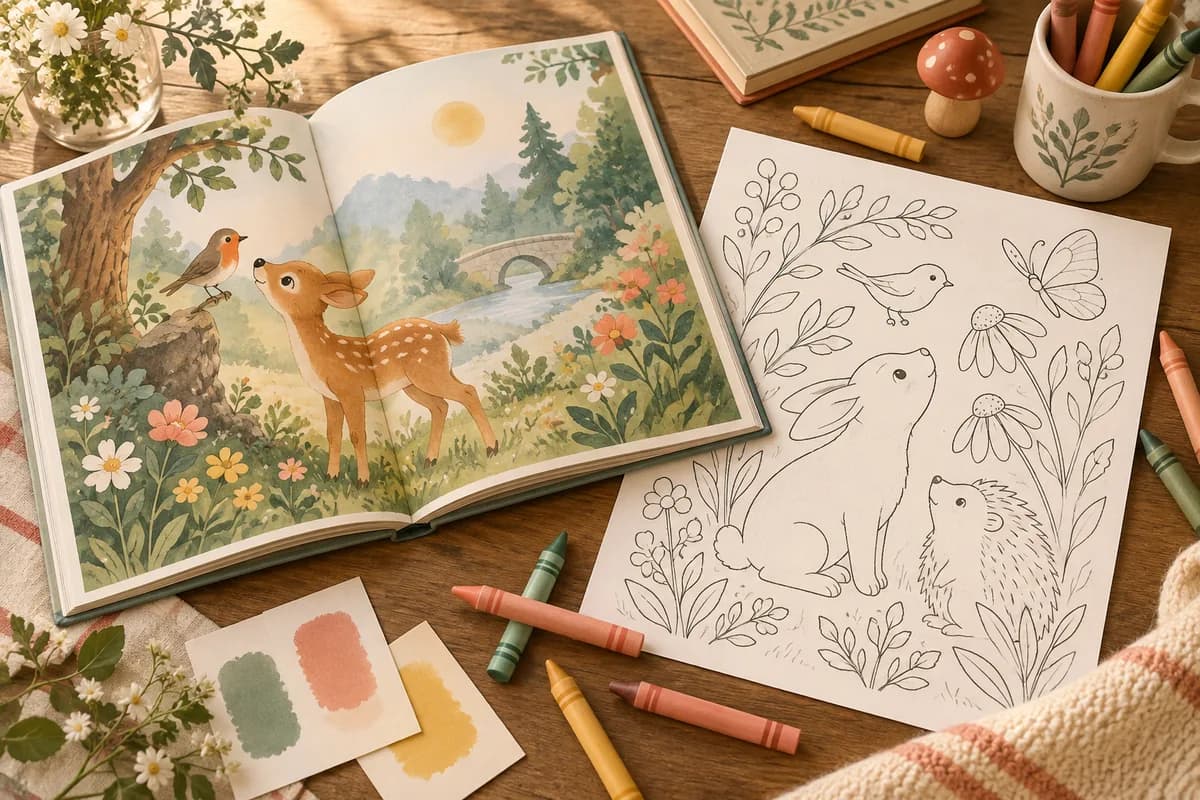
A coloring book is a product people use with their hands. A polished cover, a clever title, and a low-cost upload mean little if the pages are hard to color, lines disappear in print, or marker ink damages the next design. The sales strategy begins with a distinct audience and an original, tested set of pages. Then the creator can choose a physical book, a printable PDF, or both, and calculate what each sale actually contributes after store and production costs.
This guide separates practical design from platform rules and unit economics. It does not claim that coloring books typically earn a particular amount. Amazon and Etsy do not publish a reliable market-wide sales median for a new coloring book. A royalty table can tell you what one copy might pay under specific assumptions; it cannot tell you how many buyers will find it. We therefore use transparent arithmetic examples, reader tests, and current official policy links. For a focused aesthetic workflow, see how to make a cozy coloring book.
Choose a colorist, not just a theme
“Animals” is a theme; “large, quiet scenes for older adults who prefer broad areas and thick lines” is a product brief. A child coloring with crayons, an adult using fine pencils, and a person using broad markers need different complexity, line weight, paper expectations, and page arrangement. Define the tools the buyer likely uses. A book that calls itself “bold and easy” should genuinely have open spaces, a clear focal point, and lines that remain visible at print size.
| Intended colorist | Page characteristics | Format test | Common disappointment |
|---|---|---|---|
| Young child | Large forms, few tiny gaps, simple scene | Crayon test at actual size | Dense detail or confusing subject |
| Family activity | Varied but accessible pages, shared prompts | Two ages use the same sample | Only one skill level served |
| Adult beginner | Bold lines, satisfying but manageable detail | Marker and pencil test | Repetitive one-object pages |
| Detail-loving adult | Fine patterns with clear boundaries | Sharp pencil and print proof | Muddy lines or tiny uncolorable cells |
| Older adult with low vision | High contrast, generous spaces, recognizable forms | Read and color under ordinary light | “Easy” label on intricate pages |
| Classroom or group | Clear licensing, quick print, varied subjects | Grayscale home-printer test | Files too ink-heavy or hard to copy |
Write a brief with audience, tool, paper or file format, number of unique designs, complexity level, visual theme, recurring motifs if any, and what will make page twenty feel as worthwhile as page one. The brief should also say which subjects to avoid. A book of garden scenes might exclude tiny insects if the audience wants broad marker spaces. A child’s nature book might include recognizable local plants, but only if the art can depict them accurately.
Test the brief before drawing thirty pages
Make three sample designs at different points in the proposed range: an easy opening page, a typical middle page, and a more ambitious closing page. Print each at the intended size and use the tools the buyer is expected to use. Ask a person from the target audience to color one for ten minutes, then ask what they found satisfying or frustrating. If they cannot distinguish the subject or the lines bleed together, revise the style before creating the full set. This small test is more informative than asking whether the cover looks appealing.
Build variety into the design list
A book of thirty “cozy rooms” can become thirty nearly identical chairs by a window. Variety is not the same as randomness. Plan a controlled set of subjects, compositions, scale, visual density, and small recurring details. For a woodland book, move between a close-up of a mushroom, a wide forest path, an animal preparing food, a treehouse interior, and a rainy porch. The overall style remains recognizable while each page gives the colorist a different decision.
| Variety dimension | Options to rotate | Quality check |
|---|---|---|
| Composition | Close-up, mid-shot, wide scene | Does the whole book avoid one repeated layout? |
| Subject | Character, object, place, activity | Is the main subject clear? |
| Density | Open, medium, intricate | Does difficulty suit the intended reader? |
| Texture | Wood, fabric, foliage, sky | Is there meaningful coloring choice? |
| Mood | Sunny, rainy, nighttime, festive | Is the series coherent rather than random? |
| Interaction | Hidden detail, small prompt, recurring character | Does it reward return visits? |
Create a contact sheet of all designs before final export. At thumbnail size, can you tell one page from the next? At actual print size, are lines consistent? Are any pages unintentionally copied or mirrored? Are hands, animal legs, furniture, and text coherent? If AI contributed to the art, inspect for artifacts and impossible objects; do not make “AI generated” an excuse for poor print quality.
Original art and rights are the product
The most valuable part of a coloring book is the set of usable original illustrations. A buyer expects more than public-domain clip art pasted into a PDF. If you draw the art, retain source files and document any references. If you commission it, agree in writing on commercial print and digital use, derivatives, marketing previews, and future volumes. If you use licensed stock, check whether the license allows the asset to be sold as a page the buyer colors; some licenses restrict products where the image itself is the main value.
AI-assisted art introduces questions of tool terms, platform disclosure, consistency, and human authorship. The U.S. Copyright Office’s AI report explains that copyright protection turns on human expressive contribution; prompting alone is not automatically authorship of the output. Marketplace policies address a different question: whether the item may be listed and how it must be disclosed. KDP’s content guidelines require disclosure of AI-generated content under its definitions, while Etsy’s Creativity Standards require sellers to disclose items created with AI in the listing description. Check both at the time of publication.
| Art source | Rights record | Editorial test |
|---|---|---|
| Author-drawn | Sketches and source files | Print quality and originality |
| Commissioned | Contract, scope, usage rights, credit | Consistency and proof |
| Stock or licensed | License, receipt, permitted products | Is resale as a coloring page allowed? |
| AI-generated and edited | Tool terms, prompts, human edits, disclosures | Artifacts, continuity, traceable contribution |
| Public domain | Exact source and status in relevant territory | Quality and accurate description |
Do not copy a competitor’s page layout, distinctive character, or specific scene sequence. A theme such as “cozy cottages” is broad; the actual drawings and arrangement should be your own. If a cover or interior resembles a famous property or trademarked character, resolve that before release. A disclaimer saying “fan art” does not itself provide commercial permission.
Design one page for the real coloring medium
The ideal page has a clear focal point and open spaces appropriate to the audience. Line weight must survive the print process. Very pale gray lines may disappear; very thick black shapes can dominate the design. Details near the spine may be impossible to reach with a marker. Full-bleed backgrounds can be expensive or impractical on home printers. Test with physical media, not just an image editor.
| Feature | Crayon | Colored pencil | Alcohol marker | Home printer |
|---|---|---|---|---|
| Open area | Helpful | Optional | Helpful for even fill | Reduces ink use in outline file |
| Fine line | Often hard to follow | Can work | May be obscured | May print weakly |
| Double-sided art | Usually tolerable | Often tolerable | Bleed can ruin reverse | Buyer can choose single-sided |
| Dark background | Uses more black | Restricts palette | May feel muddy | High ink burden |
| Spine proximity | Awkward | Awkward | Especially awkward | Less relevant on loose sheets |
Single-sided designs with a blank reverse can be valuable for marker users. Do not state that blank backs make paper marker-proof: ink may still pass through onto the next sheet or surface. Recommend a protective sheet where appropriate and test the actual printed paper with common markers. The physical proof will tell you more than a paper-weight description alone.
Plan page count and print files carefully
A paperback includes front matter as well as coloring designs. If each of thirty designs has a blank back, the total may be around sixty-two pages once title and copyright pages are counted; your exact layout determines it. KDP has minimum page counts and specific trim, bleed, and margin rules. Set the final page size before drawing to avoid stretching line art. Leave a safe inner margin so a colorist can reach the design near the binding, and verify with a physical proof.
| Page plan element | Why it exists | Check in proof |
|---|---|---|
| Title page | Identify the book and artist | Correct title and legible type |
| Copyright and use terms | State rights and edition | Matches actual art sources |
| Intro or coloring tips | Explain medium and single-sided use | Short, useful, not filler |
| Each unique design | Deliver the promised activity | No duplicates or crop defects |
| Reverse page | Protect next design or add note space | Truly blank where promised |
| Back matter | Invite feedback or show series | Does not intrude on the activity |
Use a naming convention for source files and a design inventory. “01-porch,” “02-garden,” and so on let you verify that every planned subject appears once and in a satisfying order. Keep editable originals rather than only flattened PDFs. The print file may require bleed; the home-print PDF should usually fit common paper sizes with margins. Export each edition separately and test it separately.
KDP classification: coloring is generally not low-content
KDP’s low-content book guidance lists coloring books under “Not Generally Low-Content” because their pages are not usually repetitive blank interiors. A coloring book is not automatically a low-content journal merely because the buyer fills the pages. Classify the actual content under the current guidance; exceptions can exist. This affects ISBN options and how the book is presented to readers.
The Kindle content quality guide says books whose main purpose is for readers to color on the pages are not well suited to Kindle and may be rejected or removed. Do not upload the coloring activity as a Kindle ebook because it is a convenient extra checkbox. A print book and printable PDF serve the intended interaction more directly. You can separately write a text-led guide to coloring techniques as an ebook, but that is a different product.
KDP’s Expanded Distribution guidance lists coloring books among content its distributors do not currently accept. Do not promise bookstore and library availability through that route. A local bookstore can still choose to buy directly from an author under its own terms, but that requires a separate conversation and margin model. If distribution is central to your plan, investigate eligible alternatives before building the business case.
What a paperback sale might pay
KDP’s current printing-cost table and paperback royalty page should drive your calculation. The print cost depends on trim, page count, ink, paper, and marketplace. The royalty portion depends on list price and store. Use the actual file and pricing screen, not an old blog’s generic “book cost.” A large trim such as 8.5 × 11 inches can price differently from a smaller regular trim even with the same number of pages.
For an illustrative U.S. configuration, take a 62-page, large-trim, black-ink paperback with a verified $2.84 print cost and assume the relevant price band gives 60% at $9.99. The per-copy result is approximately $9.99 × 0.60 − $2.84 = $3.15 after rounding. At a lower band or a different marketplace the rate may change. This figure does not include illustration, proof, advertising, taxes, event fees, or unsold author copies. Verify the inputs in KDP before using it for a live title.
| Input | Example | How to verify your title |
|---|---|---|
| Interior pages | 62 | Count final PDF pages |
| Trim | Large | KDP trim classification |
| Print charge | $2.84 | Current calculator for store and paper |
| List price | $9.99 | Buyer and market fit |
| Royalty portion | 60% in this example | Current marketplace threshold |
| Approximate per-copy royalty | $3.15 | Rights & Pricing preview |
The useful question is not “What is the highest royalty?” but “What price and format create a fair offer and sustainable contribution?” A lower list price can be intentional if it reaches more families, but test rather than assume the increase in sales will offset the lower per-copy amount. A special paper choice may improve usability but raise print cost. A larger page can make the book enjoyable; a small cheap page may defeat the activity.
Etsy printable: a different product experience
A printable removes the print-on-demand charge but places paper, ink, and binding choices on the buyer. Design for that reality. Offer U.S. Letter and A4 versions if the target audience spans those regions, with a short printing instruction and clear personal-use terms. Leave margins for ordinary home printers; a full-bleed design may be cropped. A preview should show a real page printed on common paper, not only a mockup on a tablet.
Etsy’s digital listing help currently allows up to five files of up to 20 MB each for instant downloads and requires digital goods to be made or designed by the seller. A package might include a Letter PDF, A4 PDF, and a one-page guide, all within those limits. If a buyer needs special software, say so; preferably they should not. State whether the listing is digital only and whether pages can be reprinted for personal use. A classroom license is a separate commercial decision and should be explicit.
| Printable component | Purpose | Test |
|---|---|---|
| Letter PDF | Common U.S. home paper | Print at actual size with margins |
| A4 PDF | Common paper elsewhere | Check art and text stay centered |
| Low-ink version | Reduce printer burden | Compare line clarity |
| Instructions | Explain files and license | Can a first-time buyer follow it? |
| Preview images | Show genuine pages | Match delivered files exactly |
A direct store may suit an audience you already reach. It offers different fees and support responsibilities, so calculate its economics separately. Do not assume a marketplace listing or direct checkout generates traffic on its own. A coloring book’s discovery route may be a sample printable, an artist newsletter, a community event, or a niche search result. Whatever the route, show art that truly belongs to the book.
A production and sales budget
Illustration hours are a real cost even when the creator draws every page. Add editing or art review, cover design, proof copies, platform fees, sample prints, advertising if used, and support time. Then build conservative, moderate, and strong sales scenarios. A model is useful if the assumptions are visible; it becomes marketing fiction when the scenarios are presented as typical outcomes.
| Scenario | Copies at hypothetical $3 contribution | Gross contribution before fixed costs | What it does not include |
|---|---|---|---|
| Small test | 25 | $75 | Art, proof, time, promotion |
| Modest niche run | 250 | $750 | Same fixed costs and taxes |
| Large reach | 2,500 | $7,500 | Distribution work and potential ad spend |
If fixed production work is valued at $1,500, the small and modest scenarios do not recover it under these assumptions. The table is not a prediction that any of the copy counts will occur. For an Etsy printable, replace “per-copy contribution” with the actual price minus listing, transaction, payment, refund, and advertising costs where applicable. For an in-person book, include author-copy printing, shipping, booth fee, and card processing. A single blended margin hides important differences.
Build a listing that proves the pages are usable
A good title names the audience and actual style: “Bold Garden Scenes: thirty large-print designs for adults” communicates more than “Amazing Coloring Book.” Use search terms naturally and truthfully. Show five interior pages with varied compositions, a close-up of line weight, the physical book open on a table or a genuine home print, and the exact page count. State whether designs are single-sided and which tools have been tested. If you have not tested markers, do not promise bleed-free use.
The description should distinguish paperback from printable PDF. A physical buyer needs trim size, page count, ink and paper, shipping route, and perhaps a note about marker backing sheets. A digital buyer needs file types, paper sizes, number of unique designs, download process, and use rights. AI use must be disclosed in the way the chosen platform currently requires. Avoid keyword stuffing, invented “best seller” labels, or claims that coloring cures a condition. If the book is positioned around relaxation, describe the experience without asserting a medical effect you cannot substantiate.
A truthful listing skeleton
Who it is for: Adults who prefer broad coloring spaces and thick outlines.
What is inside: Thirty unique garden scenes, each on its own page; the paperback has a blank reverse behind each design. The printable includes the same thirty designs without blank backs.
Format: [Exact paperback trim and paper] or [exact PDF files and paper sizes]. These are separate products; select the edition you want.
Art and production: [Accurate statement of author, illustrator, and AI involvement].
Use: [Personal or classroom license terms].
The example is a structure, not a claim about a real EarnDraft-generated book. Replace every bracket with verified facts. A customer should not have to infer whether they receive a mailed book or an instant download.
Test the whole book with a contact sheet and a proof
Print a contact sheet showing every design at thumbnail scale. It exposes repetition, unbalanced difficulty, inconsistent line weight, accidental duplicate pages, and motifs that vanish. Then print five representative designs at actual size: easiest, typical, most intricate, one with a character, and one with a large dark area. Color them with the promised media. Finally, order a physical proof for the exact paperback configuration and inspect the entire book in sequence.
| Test | What it detects | Revision |
|---|---|---|
| Contact sheet | Repeated composition and missing subjects | Replace or reorder pages |
| Actual-size print | Weak or fuzzy lines | Redraw or re-export at proper resolution |
| Crayon test | Areas too small for child | Simplify shapes |
| Marker test | Bleed and reverse-page impact | Blank backs, protective sheet note |
| Binding test | Art trapped near spine | Increase inner margin |
| Grayscale test | Preview depending on color | Strengthen line contrast |
Ask a target user to color a sample without coaching. Observe where they stop, rotate the paper, or try to fill a region that is not closed by a line. Those moments show how the art behaves as an activity. A pretty image can be poor coloring art if the spaces are ambiguous. Record the findings and update the source file; do not patch only the exported PDF.
Market a coloring book with actual art
The most persuasive marketing asset is a page people can color. A free sample with clear personal-use rights lets a buyer test style and line quality. A short process video can show a page from outline to colored result. An artist’s note can explain why the theme matters and how the scenes were chosen. A school or community workshop can introduce a children’s book if the event is genuinely useful and follows organizer policies. You do not need to invent “viral trends” to demonstrate value.
| Content asset | Reader question answered | Internal link |
|---|---|---|
| Free sample page | Do I enjoy this line style? | Edition page |
| Tool comparison | Does it work with my pencils or markers? | Relevant sample and product |
| Behind-the-art note | Is the work original and intentional? | Artist/about page |
| Printable instructions | Will my printer handle it? | Digital listing |
| Physical proof photos | What does the paperback look like? | Print listing |
For search traffic, make distinct pages that answer real questions: how to print coloring pages at home, what single-sided printing changes, how a cozy coloring book is planned, or how KDP classifies activity books. Link to the actual product when it extends the answer. Do not generate dozens of thin keyword variants. The workbook selling guide covers related printable products, and children’s-book selling covers age fit when your art is for children.
Worked example: thirty designs with a coherent visual rhythm
The following line-up is a planning example for an invented adult book called Quiet Garden Corners. It is not a collection of actual generated pages, and each concept still needs an original drawing and physical test. The point is to rotate setting, scale, objects, and density so the book feels like a journey rather than a folder of interchangeable flower images. A recurring watering can can give continuity without occupying every page.
| Page | Main subject | Composition | Detail level | Distinct coloring choice |
|---|---|---|---|---|
| 1 | Seed packets on a bench | Close-up | Open | Large labels and patterned envelopes |
| 2 | Garden gate after rain | Mid-shot | Medium | Wet stone and leaves |
| 3 | Watering can beside pots | Object study | Open | Metal surface and terracotta |
| 4 | Herb shelf | Wide | Medium | Different leaf silhouettes |
| 5 | Robin on a spade | Character detail | Open | Bird and tool contrast |
| 6 | Greenhouse doorway | Perspective | Medium | Glass panes and climbing vine |
| 7 | Gloves and twine | Close-up | Open | Fabric and rope texture |
| 8 | Window box | Horizontal | Medium | Repeated pots with varied flowers |
| 9 | Snail beneath a leaf | Low viewpoint | Open | Shell pattern |
| 10 | Garden table at tea | Scene | Medium | Checked cloth and cups |
| 11 | Wheelbarrow of seedlings | Diagonal | Medium | Rows of young plants |
| 12 | Path of stepping stones | Wide | Open | Large stone shapes |
| 13 | Butterfly near lavender | Motion | Medium | Wing symmetry without tiny cells |
| 14 | Rain barrel | Object and setting | Open | Water and wood |
| 15 | First garden harvest | Hands and basket | Medium | Produce shapes |
| 16 | Fence with birdhouses | Vertical | Intricate | Different roofs and grain |
| 17 | Pruning shears and roses | Close-up | Medium | Tool, thorn, petal contrast |
| 18 | Bench under an arch | Wide | Open | Arch and shadow pattern |
| 19 | Pond edge | Low viewpoint | Medium | Water rings and reeds |
| 20 | Hanging baskets | Upward | Intricate | Trailing forms and containers |
| 21 | Cat asleep in sun | Character scene | Open | Fur, paving, plant pot |
| 22 | Vegetable rows | Wide | Medium | Leaf types and soil bands |
| 23 | Lantern at dusk | Light-and-shadow | Open | Large glow area |
| 24 | Potting shed interior | Interior | Intricate | Shelves with distinct tools |
| 25 | Bouquet wrapping | Close-up | Medium | Paper folds and stems |
| 26 | Hedge maze from above | Pattern | Medium | Clear navigable paths |
| 27 | Birdbath | Centered | Open | Water and stone texture |
| 28 | Autumn leaf pile | Motion | Medium | Distinct leaf outlines |
| 29 | Winter seed catalog | Interior | Open | Book, mug, and plan |
| 30 | Spring gate reopened | Echo of page 2 | Medium | New growth and season shift |
The line-up has an arc from preparing a garden to revisiting it through seasons. That is a design choice, not a claim that a coloring book needs a plot. The alternating density gives a buyer a choice on a day with little time. The recurring gate and watering can can make the collection feel authored. A contact sheet may still reveal that pages 4, 8, 16, and 20 all look like the same arrangement of pots; if so, redraw one. A table is a plan, not quality assurance.
Turn the line-up into an illustration brief
For each design, write the page’s focal point, background elements, line weight, intended tool, and forbidden details. A brief for the rainy gate might say: “The gate is central, with broad vertical boards and a simple latch; three leaf shapes in the foreground; wet stones but no tiny droplets; no text or signs; enough clear space for broad markers.” The brief for the potting shed should instead allow more fine detail and be marked as an optional challenge page. This approach gives an illustrator or AI-assisted workflow constraints that support the reader rather than only style adjectives.
Do not describe a page as “cozy, whimsical, intricate, minimal, bold, and highly detailed” all at once. Those directions conflict. Choose a consistent line system and vary one dimension intentionally. A style sheet can show the minimum gap size, typical line weight, border treatment, character model, and how shadows are represented. Then compare all pages against it. The cozy coloring guide explores the art direction and generation process in more detail; this selling guide focuses on the product a buyer receives.
A quality-control pipeline for illustration files
Begin with a sketch or concept, then create line art at a resolution appropriate for the final print size. Keep an editable master with layers, not only a flattened export. Examine edges at 100% and print a sample. Broken lines can cause the colorist to “escape” a region; accidental overlaps can create tiny unwanted cells. Redraw hands, faces, and perspective where necessary. Remove placeholder gibberish that AI systems sometimes place on signs or books. Verify that any animal or plant named in the listing is recognizable if accuracy is part of the promise.
| Stage | Artifact | Review question |
|---|---|---|
| Concept | Distinct page brief | Does this add variety to the book? |
| Draft art | Editable sketch or vector | Is the subject clear at intended size? |
| Line cleanup | Final master art | Are lines closed where needed and not too dense? |
| Contact sheet | Whole-book thumbnail grid | Are pages distinct and stylistically consistent? |
| Actual-size proof | Printed representative pages | Do common tools work on the spaces? |
| Full book proof | Bound physical book | Are margins, order, and reverse pages right? |
| Listing preview | Real photos or screenshots | Does marketing show the delivered file? |
The line cleanup pass is particularly important for generated art. Inconsistent outline widths and disconnected branches may look acceptable as a small thumbnail but become frustrating when colored. Convert only when the conversion improves control; an automatic vector trace can produce thousands of rough points and distorted shapes. A careful redraw of a few pages may be better than a one-click cleanup. The goal is a pleasant coloring surface, not a technical badge saying the artwork is vector.
Keep a rejection folder of pages you removed. It can reveal a repeated failure mode: too many tiny windows, cramped borders, near-identical poses, or spaces that close accidentally. Change the art brief to prevent the problem in future pages. Never quietly recycle rejected pages into a second book merely to hit a page count. If the quality is wrong for the first product, it is unlikely to become right under a new cover.
Colorability audit
Ask four questions about each page. First, can the main shapes be understood in black and white? Second, are most enclosed spaces large enough for the target tool? Third, can a colorist reach the edge near the binding or page border? Fourth, does the image offer satisfying choices rather than a mass of blank or black areas? Mark a page “revise” if it fails any question. Run the audit at actual size with a person who has not seen the brief.
For children’s pages, watch whether the subject is recognizable and whether lines survive crayon use. For adult detailed pages, test a sharpened pencil and see if the smallest spaces are intentional. For bold-and-easy pages, test a broad marker and pay attention to bleed. None of these tests require a large focus group. Three honest users can reveal a severe design flaw, though they cannot predict sales.
Compare print, printable, and direct bundles
One set of original art can support several editions, but each edition should be designed for its use. The paperback has a cover, spine, page order, and binding. The printable is a set of home-printer-friendly sheets, perhaps with a separate instructions page. A direct bundle might add a few bonus designs or a color palette sheet, but it should not merely repackage the same PDF at a higher price without explaining the difference. Buyers should know what they get and whether they may reprint it.
| Decision | KDP paperback | Etsy printable | Direct bundle |
|---|---|---|---|
| Buyer receives | Shipped physical copy | Immediate files | Immediate files, perhaps extras |
| Paper choice | Printer’s available stock | Buyer’s own paper | Buyer’s own paper |
| Margins | Bound-book inner margin | Home-printer margin | Varies by included format |
| Back pages | Can be blank behind art | Usually unnecessary in file | Buyer can choose single-sided |
| Updates | New edition or file replacement process | Replace files for future buyers | Delivery platform process |
| Discovery | Amazon search and promotion | Etsy search and promotion | Creator brings traffic |
| Support | Print issues and listing questions | Printing and download questions | File and bundle questions |
If a buyer says “I only have a small home printer,” the paperback may be simpler than a large printable. If they want to choose heavyweight marker paper, the printable may be better. If they want a physical gift, a direct PDF may be the wrong offer regardless of price. The edition comparison should appear on the author site as a small table with clear links; do not let a visitor accidentally buy the digital version while expecting mail delivery.
Calculate unit economics for each channel separately
Use current official fee and cost pages. Do not copy an old percentage from another seller’s post and assume it applies to your shop’s country or payment method. For a paperback, start with the KDP royalty preview for the exact store, trim, ink, paper, pages, and list price. For Etsy, include listing and renewal fees, transaction fee, payment processing for your location, and any applicable advertising fee. For a direct store, include payment processing, platform charge, refunds, and support. Use net contribution before fixed production cost, then model fixed cost separately.
| Channel | Revenue event | Direct deductions | Costs often forgotten |
|---|---|---|---|
| KDP paperback | Retail sale | Royalty share and print charge | Proof, art, marketing, tax |
| Author-copy event sale | In-person purchase | Author-copy landed cost and card fee | Booth fee, travel, unsold stock |
| Etsy printable | Instant-download purchase | Listing, transaction, payment, ads if used | Support, design, refunds |
| Direct digital | Checkout | Store and processing fees | Traffic acquisition and tax handling |
| Wholesale to shop | Bulk invoice | Wholesale discount and shipping | Returns, damaged stock, slow payment |
For example, if a local market paperback sells for $12 and the landed author-copy cost is $4, the apparent $8 difference is not automatically profit. Subtract card processing, booth fee allocation, damaged or unsold copies, sales tax obligations where applicable, and the time spent there. A market can still be worthwhile because readers meet the artist and may buy later; record that as a separate outcome rather than hiding it in the copy margin. If a printable sells for $5, fixed per-transaction fees may be a large percentage of price; run the actual store calculation.
Do not optimize only for price. A poor-quality $5 book can produce refunds and negative reviews; a carefully made $12 book may be more sustainable. Equally, a high list price will not create value if the pages are generic. The unit-economics sheet should be read beside the physical proof and target user feedback. The product and the financial model must support each other.
A ninety-day marketing experiment
Coloring books lend themselves to genuine visual samples, which makes marketing easier to test than abstract advice products. Run a small, bounded experiment before buying a broad ad campaign. First release one free sample page and note which audience uses it. Then show three actual interior pages and ask what tools people would use. Next put the listing live with accurate edition information. After that, test one or two acquisition routes, such as an artist newsletter and a relevant tutorial article. Record qualified visits, sales, support questions, and repeat requests.
| Period | Action | Useful measure | Decision |
|---|---|---|---|
| Weeks 1–2 | Share a free sample with intended users | Did they print or color it? | Is the style right? |
| Weeks 3–4 | Finish and physically proof the book | Defects found and fixed | Is product ready? |
| Weeks 5–6 | Publish one edition with real previews | Listing questions and conversion | Is format clear? |
| Weeks 7–10 | Test two relevant content routes | Qualified visits and purchases | Which route deserves effort? |
| Weeks 11–13 | Review feedback and economics | Net contribution and repeat interest | Update, expand, or stop? |
The sequence is a model, not a guarantee that a coloring book can be made responsibly in thirteen weeks. An illustrator may need longer; a seasonal book may need an earlier launch. Keep the sample and landing page honest. A video showing a colored page should show the same design a buyer receives. If a person colored it for you, credit them and get permission to use their work in marketing. If you use a social-media influencer, follow applicable disclosure rules for material connections.
Avoid false authority in marketplace research
When studying competing books, record visible facts: themes, formats, page previews, prices at the time viewed, review themes, and how clearly editions are described. Do not infer the seller’s revenue from rank or review count without a validated method. A bestselling badge may be fleeting. A high price may reflect an audience or bundle you cannot see. Copying the art style of a popular book does not recreate its distribution or trust.
Read critical reviews for recurring usability problems: paper too thin for the advertised tools, tiny designs, repeated pages, misleading dimensions, or a downloadable file that prints with cropped art. Those complaints can become design tests for your own product. They are not proof that all buyers want the opposite feature. Run the test with your intended colorist and state the result accurately on the page.
Use a comparison matrix, not a cloning brief. Put your book’s distinct promise in the first column, then note whether existing listings clearly meet it. Perhaps the gap is “large-format garden scenes with truly open marker areas,” or “a car-free travel sketchbook with original local drawings.” It should arise from your own skill and audience feedback, not merely a keyword with many searches. If you cannot produce materially better art or a more useful experience, choose another concept.
Accessibility is a product feature, not a label
An accessible coloring experience can mean larger shapes, stronger outlines, a comfortable page size, captions for instructional material, or an alternative downloadable format. It does not mean one design fits every person. Ask the intended audience what makes a page enjoyable and what has made previous books unusable. Some colorists want open areas because hand movement is tiring; others want a moderate challenge. Some need a high-contrast outline; others prefer a softer line. A book can state its actual characteristics without claiming universal accessibility.
For a “bold and easy” edition, measure the narrowest intended coloring spaces on a physical print. Test under ordinary home light with a broad marker and a crayon. Have a colorist who prefers large spaces use several sample pages. Ask whether the main forms are recognizable and whether repetitive backgrounds feel tiring. If a page has tiny hidden details, it may not belong in that edition. Do not rely on a thumbnail; its simplification can make dense art look deceptively easy.
| Access need | Design response | How to verify |
|---|---|---|
| Larger motor movements | Wider open regions | Actual-size coloring with target tool |
| Low vision | Strong line contrast and recognizable forms | Print under ordinary light, user feedback |
| Limited hand endurance | Varied page density and short sessions | Ask whether a page can feel complete quickly |
| Home printer limitations | Moderate ink burden and margins | Test common printer at default settings |
| Screen reader using listing | Descriptive previews and file details | Read product page without images |
| Color-vision difference | Meaning conveyed by shapes, not color codes | Inspect black-and-white preview |
If a page includes a “find the hidden animal” instruction, make the text readable and ensure the hidden figure is distinguishable without relying on a tiny color cue. A pure coloring page may not be meaningful to a screen-reader user, but the sales page should still explain what it contains accurately. Alternative text for a preview can describe the subject and line density; it need not narrate every line. An accessible product claim should be based on tests of specified features, not a vague badge.
Seasonal books: distinguish a durable theme from a calendar deadline
Holiday coloring books can be appealing because buyers know when they want to use them. They also concentrate demand into a short period and create update pressure. A “winter woodland” book may sell throughout a season and across traditions; a dated Advent activity book must be ready early enough for shipping or printing and may need a new edition when the calendar changes. Choose a title and format that match the actual content. Do not label an evergreen book “2026” merely to appear fresh in search.
| Theme type | Example | Shelf life consideration | Production decision |
|---|---|---|---|
| Evergreen interest | Garden scenes, cozy kitchens | Can remain relevant | Invest in durable art and sample pages |
| Broad season | Autumn forest, winter cabins | Repeats annually | Avoid dates unless needed |
| Specific holiday | Halloween party, Lunar New Year | Timing and cultural context matter | Plan ahead and seek relevant review |
| One-time event | Local festival coloring pages | Location and date can change | Verify permissions and use a small run |
| Educational calendar | Thirty-day class activity | Schedule and school needs matter | Test with educators before launch |
Seasonal marketing should begin while a buyer can still use the book. For a paperback, allow time for print proof, listing approval, and delivery; the exact timing varies. For a printable, immediate delivery helps late buyers but does not excuse a rushed file. If the theme draws on a specific culture or religious tradition, ask a knowledgeable reader to review symbols, names, and context. Respecting the subject is part of product quality.
Keep a visual evidence file
An artist’s production folder can double as a trust archive. Save rough sketches, rejected concepts, source art, line-cleanup versions, the contact sheet, print tests, proof photos, licenses, and the final export. Date each. If a buyer later reports that page 17 has a broken line, you can find the editable source and repair the edition. If a marketplace asks about rights, you can show how the work was made. If a freelancer contributed, keep the contract and delivery record with the relevant files.
| File | Why keep it | Public or private? |
|---|---|---|
| Concept grid | Shows intended variety | Can show a sanitized version |
| Editable master art | Enables precise corrections | Private source file |
| License or contract | Proves commercial use scope | Private unless needed |
| Contact sheet | Reveals repetition | Useful in process article |
| Test prints | Shows line behavior | Selected photos can be public |
| KDP proof notes | Tracks print corrections | Private working record |
| Final PDF and version | Identifies delivered product | Customer receives appropriate edition |
Version the files clearly: garden-coloring-v1.0-letter.pdf is more maintainable than final-final-new2.pdf. Keep the source art separate from marketplace files so a future A4 export does not accidentally stretch a Letter page. If you change the book after buyers have purchased, describe the substantive update in a changelog and use the delivery platform’s supported update process. A corrected line on page 17 is worth mentioning; a slightly different listing thumbnail usually is not.
A complete product-page audit
Before publishing the listing, compare every claim with an artifact. If the title says “thirty designs,” count thirty unique design files. If the page says “single-sided,” flip through the physical proof and verify that the reverse of each art page is blank. If it says “works with markers,” name what you tested and any backing-sheet advice rather than implying bleed can never happen. If the PDF is described as “printer ready,” print it on common Letter and A4 paper. If an image is described as a sample, ensure it appears in the delivered book.
| Listing claim | Artifact to inspect | Risk if wrong |
|---|---|---|
| Number of unique designs | Inventory and final PDF | Buyer receives repeated pages |
| Paper or trim | Physical proof and store details | Unexpected size or feel |
| Single-sided pages | Bound proof | Marker affects next image |
| Printable sizes | Each exported and printed PDF | Cropped or scaled art |
| Art provenance | Contracts and source log | Rights or disclosure dispute |
| Intended age or difficulty | User test and actual page density | Frustrated colorist |
| License | Written terms in listing and file | Unclear classroom or resale use |
Use actual product photos where possible. A styled photograph can be attractive, but it should show the real page size and line weight. A digital mockup can supplement, not replace, evidence of a printed page. Photograph the book under natural light and avoid editing out paper bleed or margin defects. If the product is downloadable, make the “digital only” distinction visible near the purchase action, not buried at the end of the description.
Microcopy for a trustworthy listing
“Thirty unique designs” is better than “hundreds of coloring possibilities” if the latter merely counts possible colors. “Tested with colored pencils; place a protective sheet behind a page when using markers” is more useful than “marker proof.” “Digital PDF, no physical product shipped” resolves a common source of dissatisfaction. “For personal use; classroom license sold separately” defines scope. These small phrases reduce ambiguity and support conversion because a buyer can choose confidently.
An artist-led content plan for search and social
Make content from the real process. A short article can show how one design changed after a marker test. Another can compare the same page on inexpensive copy paper and a thicker sheet, without presenting the result as a universal paper ranking. A video can show a time-lapse of an original drawing and link to the sample page. An email can invite readers to color the sample and reply with what they would change. Each asset answers a genuine question and connects naturally to the book.
Do not publish generic posts that merely repeat “coloring is relaxing” with no evidence or original visuals. If discussing health effects, distinguish personal experience from substantiated claims; avoid saying the book treats anxiety or another condition. The FTC’s health-products guidance is relevant if marketing makes objective health claims. Most coloring-book sellers can communicate value by showing the art, the tactile experience, and the intended user without promising medical outcomes.
| Content idea | Original proof | Search or social value | Link destination |
|---|---|---|---|
| “How we tested bold lines” | Photos of actual print and marker | Demonstrates usability | Sample page and edition choice |
| “One scene, three compositions” | Sketch variations | Shows deliberate art direction | About the book |
| “Print at home without cropped edges” | Letter and A4 test | Solves buyer problem | Printable listing |
| “What single-sided means” | Physical flip-through | Clarifies format | Paperback listing |
| “Thirty-page garden arc” | Contact sheet excerpt | Shows variety | Full book preview |
Internal linking should help the reader navigate from education to sample to product. A buyer who wants an unrelated topic should also have a route to the broader publishing guides. The same article should not be spun into five pages whose only difference is “adult,” “kids,” “cozy,” “cute,” or “easy” in the title. Distinct audience needs can justify distinct books and pages only when the underlying art and explanation differ materially.
A small buyer test with clear questions
Show three people from the intended audience an unbranded sample and the proposed listing. Ask them what they expect to receive, which tool they would use, how difficult the pages appear, and what price feels fair relative to similar products they have bought. Then reveal the full book contact sheet and ask whether the variety meets that expectation. A price answer alone is weak; it becomes useful when paired with the reasons a person gives for valuing or rejecting the book.
If a marker user says the pages look too delicate, do not change the title to “for pencils” without reviewing all pages. Either improve the art or position the book truthfully for the tool it supports. If a caregiver says the book looks too hard for a six-year-old, verify with actual age-appropriate testing before changing the age range. Buyer language can guide listing clarity, but it should not override physical evidence. The test is a decision aid, not proof of market demand.
After the listing is live, log repeated questions. “Does a paperback ship?” suggests format confusion. “Can I print each page twice?” suggests the license needs plain language. “Are the backs blank?” suggests the product photos do not show enough. Fix the listing and, where the issue is core to the book, fix the artifact. Better support copy is no substitute for a usable interior.
One-page decision exercise: should this book launch?
Before setting a publication date, score the project on evidence rather than enthusiasm. Put the finished contact sheet, three colored test pages, one physical proof or home-print test, rights records, and the proposed listing on the table. Ask a reviewer who did not make the art to inspect them. For each question below, write “yes,” “needs work,” or “unknown,” with a short reason. An “unknown” is a task, not a pass.
| Gate | Evidence for yes | If the answer is no |
|---|---|---|
| Distinct audience | Specific colorist and tool named | Narrow the brief and test again |
| Visual variety | Contact sheet shows meaningful changes | Replace repeated compositions |
| Colorability | Target user has colored sample pages | Redraw cramped or confusing regions |
| Print quality | Actual-size pages and physical proof pass | Fix line and margin files |
| Rights | Source files and licenses cover both editions | Obtain permission or replace art |
| Store fit | Product matches platform format rules | Change channel or product format |
| Economics | Current costs modeled for each channel | Reprice or reduce avoidable expense |
| Listing truth | Every claim matches delivered file | Rewrite claim or fix file |
| Discovery route | At least one relevant audience channel exists | Run a small sample test first |
Suppose the Quiet Garden Corners contact sheet shows thirty visibly distinct pages, but two test colorists find page 16 too intricate for a “bold and easy” label. The launch gate fails because the promise is inconsistent. The creator can simplify that page, move it to a bonus “detail challenge” if clearly labeled, or reposition the entire book after broader testing. The cheapest fix is not always a copy change; if the intended user needs bold spaces, the art should meet that need. Conversely, if twenty-nine pages are intricate and only one is open, the book may be correctly described as detailed rather than bold. The evidence should decide.
Now imagine the sample passes, but the Etsy listing says “printed book” because the author copied language from a paperback description. That is a separate failure. Correct it before launch and place “digital download” near the title and purchase action. A beautiful product can still disappoint if the buyer chooses the wrong edition. One final proof of the actual checkout path can prevent avoidable refunds and reviews that discuss delivery instead of the art.
The exercise also helps a creator decide not to publish yet. If rights to a stock design are unclear or a print proof has broken lines, pausing is progress. A marketplace listing is easy to create; repairing trust after buyers receive a weak book is harder. When every gate has evidence, the author can launch with a clear account of what was tested and what remains a matter of buyer preference. That is a more durable position than promising an income figure no one can verify.
After publication, keep the gate sheet with the source files. A later return or support request can be traced to the original decision: was the issue tested and missed, or did the listing change? Review the gate sheet before releasing a second volume. If the first book’s strength was its broad spaces and calm scenes, a follow-up should preserve those strengths while introducing genuinely new subjects. If buyers mainly complained about file size or paper, fix that process before drawing another thirty pages. A series is a promise of a consistent experience, and the evidence from one book should improve the next.
If a collaborator takes over layout or marketing, the gate sheet also provides a concise handoff. It says which features are intentional and which claims have proof. Without it, a well-meaning marketer may promise “marker proof” because the designs are single-sided, or crop a cover so the page style appears different. Keeping the product, listing, and visual previews aligned is ongoing editorial work.
Common mistakes to avoid
Counting designs but not checking uniqueness. A book can have thirty pages and only ten distinct ideas. Use a design matrix and contact sheet, then replace near-duplicates.
Treating blank reverse pages as magic marker protection. Paper can still bleed through. Test real media and recommend a backing sheet if needed.
Classifying every coloring book as low-content. KDP says coloring books are generally outside that category. Read current guidance and classify the actual interior.
Offering a Kindle coloring book as a bonus. KDP says books meant mainly for coloring on pages are unsuited to Kindle. Make an activity format people can use.
Promising broad distribution through a route that excludes coloring books. KDP Expanded Distribution currently lists them among not accepted content. Sell via eligible routes you have verified.
Using unreviewed generated art. Lines can be broken, repeated, or nonsensical. Human review and physical testing are essential.
Publishing a printable with no print test. Common home printers have unprintable margins, variable grayscale, and paper costs borne by the buyer.
Assuming a margin proves income. A $3 per-copy contribution is meaningful only after a sale; it says nothing about demand or production expense.
Frequently asked questions
Can I sell the same coloring art as a paperback and a PDF?
Often yes if you own or have licensed both print and digital distribution rights. Prepare separate files suited to the medium and describe each edition honestly. A print version may include blank backs; a printable may omit them to save paper. Check the terms of any illustrator, stock, or AI tools involved.
Are coloring books low-content on KDP?
KDP lists coloring books as not generally low-content. Its guidance notes possible exceptions, so classify the actual interior under current rules rather than relying on the book’s label.
Should I make a Kindle version?
KDP’s Kindle quality guidance identifies books whose main purpose is coloring on the pages as unsuitable. A paperback or printable file serves that use. A separate reading-focused guide to coloring is a different product.
How many designs should a coloring book have?
Enough distinct, tested designs to fulfill its promise at the chosen price and format. A plan of thirty unique pages can be substantial; a plan of sixty recycled variants is weak. Page count should follow the audience and production economics, not an arbitrary “more is better” rule.
Should every design have a blank back?
It can improve usability for marker users and allow page removal, but it does not prevent all bleed-through. Test the actual paper and media. In a printable edition, let the buyer print single-sided and explain the setting.
What should I disclose if AI helped create the art?
Follow the current rules of each store and describe the role accurately. KDP asks about AI-generated content in title setup, and Etsy requires disclosure in a seller-prompted AI listing description. Keep records of human selection and editing for your rights and quality process.
Can a coloring book go to bookstores through KDP Expanded Distribution?
KDP’s current Expanded Distribution requirements list coloring books among content not accepted by its distributors. Other distribution arrangements may exist; verify their terms separately. A local shop can be approached directly with an appropriate wholesale offer.
How do I know whether a niche will sell?
No universal statistic predicts sales. Study the intended colorist, compare real products serving the same use, test sample art, choose a reachable audience, and model scenarios with transparent costs. A niche works when the book offers something people value and they can find it.
Sources, limitations, and next step
This guide draws on official KDP, Etsy, and U.S. Copyright Office materials checked in September 2026. The sample prices and book concepts are illustrative arithmetic, not reported seller results. We did not access transaction data or estimate typical coloring-book income. Store costs, thresholds, and rules can change; use the current official calculator and policy when publishing.
- KDP, low-content books: classification of coloring books.
- KDP, Kindle content quality: books meant to be written or colored in.
- KDP, Expanded Distribution: content exclusions.
- KDP, print cost, paperback royalty, and trim and bleed: economics and files.
- Etsy, digital listings and Creativity Standards: delivery, original design, and AI disclosure.
- U.S. Copyright Office, AI initiative: human authorship context.
Begin with three sample designs. Print and color them with the tools your intended buyer will use, then build the full design list. Plan your book once the audience and art direction are clear, and treat the final human proof as part of the product.