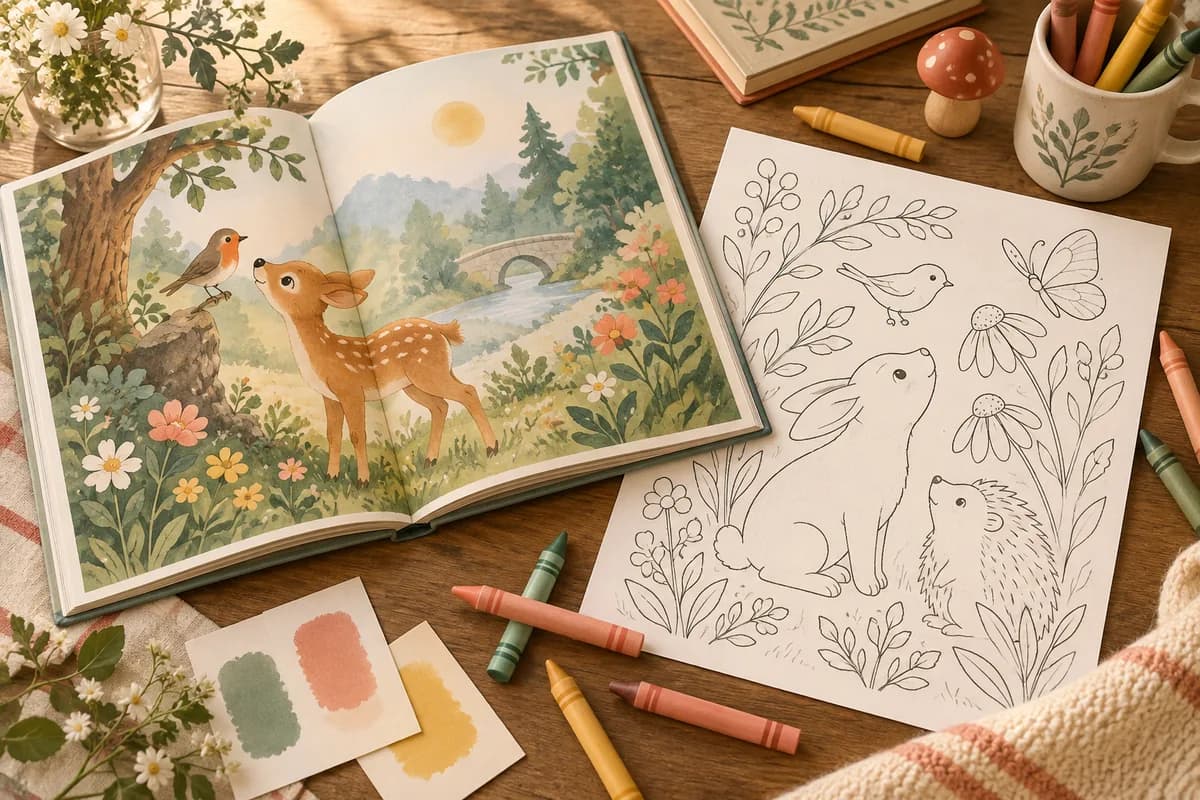
The buyer of a children’s book is often an adult, but the book succeeds or fails with the child. A parent may search for a story about the first day of school; the child decides whether to ask for it again. A teacher may need a read-aloud that fits ten minutes; a wordy page can lose the room. A gift buyer may choose by cover and age range; the interior must justify that promise. Selling well therefore begins with an excellent age-appropriate reading experience, then a production plan and a channel suited to the format.
Every edition deserves its own proof, and every sales claim should be traceable to pages a family can actually read together.
This guide covers picture books, early readers, and short chapter books; print, Kindle, and direct digital editions; realistic per-copy math; proofing; rights; and marketing that respects families. It does not claim to know typical sales for a first children’s book. Store fees tell you what a copy could earn when it sells, not how many copies anyone will buy. Where platform rules or costs matter, verify them again in the official dashboard before publication.
Decide which child and which reading moment you serve
Children’s publishing is not one market. A board-book concept for a two-year-old, a picture book read aloud to a five-year-old, and a chapter book for an independent nine-year-old have different vocabulary, page turns, art, and buying contexts. The more precise your reader and occasion, the easier it is to edit the manuscript. “A story about courage” could be anything. “A gentle bedtime story for a four-year-old nervous about sleeping at a grandparent’s house” gives you a conflict, length, rhythm, and emotional boundary.
| Format | Likely reading mode | Design priority | Sales-page evidence |
|---|---|---|---|
| Very young picture book | Adult reads, child points and repeats | Strong images, simple language, durable rhythm | Interior spreads and reading age |
| Picture book | Read aloud, then child retells | Page turns, visual storytelling, voice | Two or three representative spreads |
| Early reader | Child decodes with some support | Controlled complexity, visible type, short chapters | Sample page at actual size |
| Short chapter book | Child reads independently or with adult | Character continuity, chapter momentum | Opening chapter and series promise |
| Activity/story hybrid | Child reads and participates | Clear instructions, usable space | Photo of activities actually completed |
Amazon KDP’s primary audience and reading-age guidance says an appropriate reading age can affect eligibility for children’s categories and age-specific results. Its example bands include ages 3–5 for picture books, 6–8 for early readers and first chapter books, and 9–12 for middle-grade chapter books. Those are storefront metadata ranges, not a substitute for reading the manuscript with actual children. Set the age honestly, and test the book with people in that range under appropriate parental or school supervision.
A one-page story brief
Before drafting, write the child’s approximate age, whether the adult or child reads, the moment of use, the protagonist’s desire, the obstacle, the emotional shift, the page or chapter length, and what the child can notice in the pictures that the text does not say. The last field is important. A picture book whose illustrations merely repeat every line loses half the medium. A visual joke or recurring detail can make rereading pleasurable without adding more words.
An invented example: “A child who loves collecting stones tries to bring a whole beach home, then learns to choose one memory and leave the shore for others.” The concept offers tactile art, a real page-turn choice, and a gentle theme. It does not require a lecture on environmental ethics. If the story is for four-year-olds, read it aloud and listen for breath, difficult phrasing, and the child’s questions.
Make the manuscript work before formatting it
Draft the story in scenes or spreads, not as a block of prose later chopped into pages. Each turn should change something: a new attempt, a surprise, a feeling, or a visual reveal. Repetition can help young readers predict and participate, but it should develop rather than duplicate the same event. An early reader needs a clear reason to turn to the next chapter, not simply short sentences.
| Draft check | Question | Revision move |
|---|---|---|
| Opening | Does the child encounter the central desire quickly? | Start closer to the action. |
| Agency | Does the child character make meaningful choices? | Let adults support rather than solve everything. |
| Page turn | Is there a reason to reveal the next spread? | Move a surprise, question, or visual clue. |
| Language | Can the intended reader or listener follow it? | Read aloud; replace abstract summary. |
| Illustration role | Does art add information or emotion? | Remove text that merely describes visible art. |
| Ending | Does it resolve the promise without preaching? | Show a changed action rather than a moral label. |
Read the manuscript aloud at normal pace. Time it if it is intended for a classroom or bedtime. Then ask a child what happened, which page they liked, and what they think the character wanted. Do not force a “correct” interpretation; unexpected answers can reveal whether the narrative is clear. Give caregivers and educators a way to report confusing language. Their feedback is helpful, but a child’s actual attention and request to revisit a page are equally important signals.
Plan illustration and rights from the first draft
Art is not a final decoration. It determines pacing, character continuity, and whether a child understands a scene. Create a character reference sheet with consistent clothing, proportions, colors, and recurring objects. A spread plan should describe what the art communicates beyond the line of text. If you hire an illustrator, agree in writing on scope, revisions, commercial formats, territory, credit, and whether source files are delivered. If you use licensed art, confirm it permits book covers, interior printing, digital editions, and marketing previews.
AI-generated images require additional editorial work. A model may alter a character’s features across pages, change the number of fingers, place a safety hazard where the story needs a safe action, or draw text that looks like a real word but is not. Review every image at print size and with the manuscript beside it. Do not assume a successful cover image means a coherent interior. KDP’s content guidelines require disclosure of AI-generated content under their definitions; check the current rule during title setup. Etsy’s Creativity Standards have their own seller-prompted AI disclosure requirement. The store’s rules are separate from the U.S. Copyright Office’s human-authorship guidance.
| Art decision | Ask before production | Proof before launch |
|---|---|---|
| Commissioned illustration | Who owns which rights and files? | Credit and permitted uses match agreement. |
| Stock illustration | Does license allow resale within a book? | License record is retained. |
| AI-generated art | What human work and store disclosure apply? | Continuity, anatomy, text, and rights reviewed. |
| Public-domain art | Is the exact edition or scan usable? | Attribution and source history checked. |
| Photographs of children | Is consent specific and current? | Privacy and commercial use approved. |
An illustration budget is not only a line in your spreadsheet. It is the cost of the book’s visual narrative. If the budget cannot support fully illustrated pages, consider a text-led early reader with spot illustrations or a shorter original story rather than a long picture book with inconsistent art. The child’s experience should decide the format.
Build a page plan before you pay for print
Print-on-demand has physical constraints. KDP’s trim, bleed, and margin guide explains how art that reaches the edge must extend into bleed and how text needs safe margins. A full-bleed illustration set to the wrong page dimensions can be rejected or trimmed awkwardly. A book needs title and copyright pages as well as story pages. Count the actual interior page total and identify where a spread crosses the gutter. Check whether important faces or words sit too near the binding.
| Interior part | Purpose | Common oversight |
|---|---|---|
| Title page | Confirm title and authorship | Different title from KDP metadata |
| Copyright and credits | Record rights and edition | Missing illustrator or translation credit |
| Story opening | Establish character and desire | Too much exposition before the first action |
| Main spreads | Deliver scene-by-scene change | Each spread repeating the same visual idea |
| Ending | Resolve the emotional arc | Moral explained after story has already ended |
| Back matter | Optional activity, author note, series link | Sales copy that overwhelms the story |
For a 32-page picture-book mockup, put the manuscript into a folded paper dummy. Draw simple rectangles for art. Read it to someone while physically turning pages. You may find a reveal occurs on the wrong side, an illustration needs more space, or a page has far too many words. A dummy costs almost nothing and can prevent an expensive redesign.
Understand KDP print economics before setting a price
For a KDP paperback, per-copy royalty is based on the list price, the marketplace’s royalty rate, and the printing cost. Color interiors cost substantially more than black ink, and trim size matters. KDP’s printing-cost page and paperback royalty page are the sources to use for the current rate; the dashboard preview for your exact file is the final check. A square picture book can fall into a large-trim category and cost more than a regular-trim calculation suggests.
Do the calculation in stages. First choose the actual trim and interior ink. Second use the number of final interior pages, including front matter. Third find the relevant store’s print cost. Fourth apply the current royalty percentage for the list price and marketplace. Fifth subtract the print cost. Do not use one U.S. result for every country. Taxes, currency conversion, and distribution terms can differ.
| Price decision | Why it affects a picture book | Verification |
|---|---|---|
| Trim size | Square and wide sizes may cost more to print. | KDP size classification and calculator |
| Color mode | Full-color art typically requires premium color at short lengths. | Proof and current cost table |
| Page count | A few extra pages can alter printing cost bands. | Final print-ready PDF page count |
| Marketplace | Print costs and thresholds vary. | Price screen for each store |
| Distribution | Retailer direct and expanded distribution may pay differently. | KDP’s current distribution terms |
Illustrative arithmetic: If a print edition lists for $12.99, the applicable royalty portion is 60%, and the verified printing charge for that exact configuration is $4.20, the pre-tax, pre-ad royalty would be approximately $12.99 × 0.60 − $4.20 = $3.59 after rounding. This uses an example configuration often discussed for a short color picture book; confirm all inputs in KDP before treating it as your own result. It says nothing about unit sales, illustration expense, returns, or time spent writing.
Why one cent can matter
KDP’s paperback royalty schedule may have a price threshold that changes the percentage, so an apparently tiny price change can produce a larger royalty change. Check the current marketplace threshold on the official royalty page and model your exact book both just below and just above it. Then consider buyers. A higher royalty per copy is useful only if the price still fits the perceived value and the intended family’s budget. Arithmetic guides a choice; it does not make the choice automatically.
Kindle, PDF, and print serve different reading behaviors
Picture books are often a strong print experience: the adult and child share a spread, point, and turn together. A Kindle version can work when the art and text are laid out for the supported reading experience, but a large image-heavy file can create delivery costs under some royalty options. KDP’s ebook royalty documentation explains delivery charges and option constraints. Use the file you will actually upload in the royalty preview, not a text-only estimate.
Early readers and chapter books may be better ebook candidates because text can reflow and readers can adjust type size. A direct-sale PDF can preserve an illustrated layout but may be awkward on a phone. Give the buyer a real preview and say whether printing is allowed. If you sell through Etsy, its digital listing help says files must be made or designed by the seller and currently permits up to five files of up to 20 MB each. A print-ready PDF and a screen-friendly PDF can be distinct files; test both.
| Edition | Best use | Technical proof |
|---|---|---|
| Color paperback | Shared reading and gifting | Physical proof under normal light |
| Kindle picture book | Device-based shared reading | Supported fixed layout and actual device preview |
| Reflowable early reader | Independent device reading | Adjustable type and clean navigation |
| Printable PDF | Home or classroom use under license | Paper sizes, margins, ink load |
| Read-only PDF | Exact illustrated layout | Phone legibility and file size |
Do not claim every edition is equivalent. A child who writes or colors in the book needs a physical or printable edition, not a static Kindle image. A family reading on a phone may need larger text and less detail than the print spread. One manuscript can support multiple editions, but each requires its own proof.
Order a proof and read it with a child
A digital preview is necessary and insufficient. Paper changes color, contrast, and the feeling of a page turn. Order a physical proof for the exact trim, color mode, and cover. Look for cropped art, dark scenes, faces lost in the gutter, thin strokes, muddy colors, unreadable text, and paper show-through. Read the proof aloud to a child in the intended range, with appropriate consent. Notice where they interrupt, point, laugh, or lose interest. This is not a formal sales study; it is a product test that can expose what the author’s screen cannot.
| Proof test | What to observe | Likely fix |
|---|---|---|
| Cover at shelf size | Can title and character be understood? | Simplify composition and type. |
| Interior in evening light | Is text readable? | Increase contrast and size. |
| Gutter spread | Is a face or word swallowed? | Shift focal content outward. |
| Read-aloud rhythm | Where does the adult stumble? | Shorten or rephrase sentence. |
| Child retelling | Which event or character mattered? | Clarify causality visually. |
| Page durability | Does handling feel appropriate? | Reconsider format or expectations. |
Make one revision list from both print and reading feedback. Fix structural issues before cosmetic ones. If a child repeatedly misunderstands why a character acts, a prettier background will not resolve it. If the pages are too dark, the manuscript may be excellent but the print file still needs correction. Confirm with a second proof only when the changes affect printed output.
Choose the first sales channel with intention
Amazon KDP gives access to book shoppers but does not guarantee discovery. Direct digital stores make sense when a creator already has a relevant audience, such as a parent newsletter or educator community. Etsy can suit original printable stories or activities when buyers search for instant downloads, but the product must fit its design and disclosure rules. Local bookstores, school fairs, library events, and markets can support a printed book when the author can attend, bring appropriate copies, and communicate with organizers respectfully.
| Channel | Buyer context | Author work | Fit to test |
|---|---|---|---|
| Amazon paperback | Searches or recommendations for a physical book | Metadata, proof, listing, promotion | Is age and sample clear? |
| Amazon Kindle | Device-based reading | Layout, file-size economics, preview | Is art or text readable? |
| Etsy digital | Search for printable or instant file | Real preview, file delivery, shop terms | Is the product truly printable? |
| Direct digital store | Audience comes through creator | Traffic, support, updates | Is there a trusted route to the page? |
| Local event | Parent, teacher, child meet author | Inventory, display, reading, payment | Does the story work aloud? |
| School or library | Educational or community use | Permission, scheduling, age fit | Does it serve their program? |
Avoid selling proof copies. KDP’s proof copies are marked for review; author copies are the appropriate route for selling printed copies obtained through your account under current KDP rules. Calculate the landed cost including printing and shipping before setting an event price. For a local shop, discuss wholesale terms and returns before promising a margin. Direct sales can earn more per copy but add fulfillment work, inventory risk, and customer support.
Write metadata for the adult buyer without forgetting the child
The title and subtitle should help an adult recognize the reading moment while staying truthful to the story. A book about starting school should not stuff “school anxiety preschool kindergarten bedtime read aloud educational” into a clumsy title. Put the natural title first, then a concise descriptive subtitle if appropriate. KDP’s metadata guidance governs title, contributor, series, categories, and keywords; check it before uploading. Set the reading age accurately and choose categories that match the content, not only those that seem less competitive.
A strong description begins with the child’s situation and the story’s hook. It then explains age, format, length or page count, and what makes this edition distinctive. It may mention a discussion prompt or bonus activity if one actually exists. It should not promise that the book will cure fear, teach every reading skill, or become a bestseller. Show two or three real interior spreads. The cover can communicate tone, but parents and educators judge readability and illustration consistency from inside pages.
Example: one story, three audience angles
Suppose the fictional Mina and the Lost Kite is a picture book about asking for help after a windy-day mistake. A parent-facing description might emphasize a gentle read-aloud about trying again. A teacher-facing note might describe two open-ended discussion questions about problem solving. A gift-facing line might mention the bright art and target age. These angles are different entrances to the same truthful product. They should not become three near-duplicate books or pages that imply different content.
| Adult buyer | Main concern | Page element |
|---|---|---|
| Parent | Will my child enjoy and understand this? | Sample spreads and read-aloud length |
| Grandparent or gift buyer | Is it right for this age? | Age range, format, cover and interior photo |
| Teacher | Can it support a class moment? | Theme, session length, discussion questions |
| Librarian | Will it hold up in a collection? | Bibliographic details and genuine reviews |
The adult buys, but the child’s response determines word of mouth. A marketing promise built from observed use is stronger than a list of educational buzzwords.
Build an honest launch plan
Begin with people who can give useful feedback, not a mass message asking for five-star reviews. Share a sample with a small set of caregivers or educators who fit the intended audience, explain that you want candid response, and follow the retailer’s current review rules. Do not trade a free copy for a specific rating. The FTC’s endorsement guidance is relevant when a promoter has a material connection to the author. A real review that names a specific page or child reaction is more valuable than a generic testimonial.
| Launch asset | What it should show | What to avoid |
|---|---|---|
| Sample spread | Real art and text at readable size | Cover-only mockup presented as interior |
| Read-aloud clip | Natural pacing and page turns | Child’s image or voice without consent |
| Educator note | Appropriate discussion or activity | Claiming curriculum alignment without review |
| Author note | Why the story was made | Unverifiable “award-winning” authority |
| Event flyer | Time, age fit, purchase route | Pressure to buy in a school setting |
| Email announcement | Audience and sample | Repeated blasts to unrelated contacts |
School and library visits require respect for staff time and policies. Offer a reading that stands on its own even if no one buys. Ask about age group, session length, AV needs, accessibility, and whether sales are permitted. Bring author copies only if requested or allowed. A free coloring page based on your own character can extend engagement, but rights in the illustration must cover that use. For a story series, a subsequent genuinely good book can create repeat interest; do not rush one merely to expand the catalog.
Use SEO to reach the right adult question
Search pages should answer real decisions. A guide on “how to read with a child who is nervous about a new school” can be genuinely helpful and then link to a relevant story sample. A page about making a picture book can explain page dummies, illustration briefs, and proofing. A store page can answer age, trim, file format, and shipping. These pages have distinct purposes. Creating dozens of near-identical keyword variants or fabricated “best books” rankings is a weak acquisition strategy and a maintenance burden.
Internal links should serve a path: advice article → story sample → edition page → checkout, with optional links to related books and a transparent author page. On EarnDraft, our guide hub connects publishing topics; KDP ebook royalties explains digital economics; selling workbooks covers printable activity products. A reader who wants to create a general book can start a draft, then apply human editing and the specialist production steps described here. Do not imply the product automatically illustrates, formats, or publishes a picture book unless the current app demonstrably does so.
A content cluster with distinct value
| Page | Search intent | Original evidence to include | Next link |
|---|---|---|---|
| “How to make a picture-book dummy” | Production learning | Photos of actual paper dummy and page-turn test | Full children’s-book guide |
| “Picture-book print costs” | Pricing decision | Dated KDP calculation for real configuration | Edition listing |
| “Read-aloud activity for first school day” | Parent or teacher help | Tested questions and printable activity | Story sample |
| “About the author and illustrator” | Trust and rights | Real bios, process, credit | Book editions |
The content cluster is not a command to publish every possible article. Start with the question you can answer best from firsthand work. Maintain the pages when KDP costs, policies, or your book editions change. A single original diagram of a page plan may earn more trust than ten generic blog posts.
Model income without turning examples into promises
A per-copy royalty is a unit-economics number. A project profit depends on how many copies sell and what it cost to make and promote them. Illustration, editing, ISBN choices, proof copies, event travel, ads, and author time can be substantial. Use three sales scenarios and the actual net contribution of each edition. The scenarios below are arithmetic examples, not forecasts or industry medians.
| Scenario | Copies | Net contribution after direct store and print costs | Total contribution before fixed production costs |
|---|---|---|---|
| Small local launch | 30 | $3 per copy | $90 |
| Sustained niche interest | 300 | $3 per copy | $900 |
| Strong wider reach | 3,000 | $3 per copy | $9,000 |
If fixed illustration and editing expenses are $3,000 in this hypothetical, the first two scenarios do not recover them; the third exceeds them before taxes and overhead. If the book is a nonprofit or school project, recouping every dollar may not be the only objective, but the cost still needs an owner. The formula is copies × edition-specific contribution − fixed costs − promotion and fulfillment costs. A discounted event copy, a direct PDF, and a KDP paperback each need their own contribution figure.
For event pricing, calculate landed author-copy cost: printing plus shipping and any handling, then add event fees and payment processing. If a bookstore orders at a discount, model that route separately. Do not use the online paperback royalty as though it were the margin on a box of copies sold in person. Keep inventory modest until real demand appears. A warm audience of thirty families may be more valuable for early learning than a thousand untargeted ad impressions.
Common errors that cost money or trust
The book is too broad for an age range. If a child can read the words but not understand the emotional arc, or vice versa, the age label is not doing its job. Test with the intended audience and align KDP reading-age metadata with the actual content.
The art looks beautiful but changes the character every spread. Make a character sheet, compare pages side by side, and use a human art review. A child often notices continuity errors before an adult marketer does.
The first print file is treated as final. Proof at actual size, read it aloud, and inspect the gutter and color. Fix the book before selling event copies.
The ebook is priced without delivery cost or device testing. Image-heavy files can have different economics and usability from text-led books. Use the actual file in KDP’s preview and royalty calculation.
The listing promises a developmental outcome. A story can support conversation without guaranteeing it will teach empathy, eliminate anxiety, or improve reading level. Describe what is in the book and show a sample.
The author asks for glowing reviews. Invite honest feedback under current store rules. Disclose material connections in promotional endorsements.
The seller copies a “typical copies sold” statistic with no source. Storefronts do not provide a reliable market-wide median for a first picture book. Plan with transparent scenarios and measure actual results.
Worked page dummy: a fictional 32-page picture book
The following page dummy is an original planning example for the invented Mina and the Lost Kite. It is not a manuscript to paste into a book. Its purpose is to show how narrative, illustration, front matter, and page turns fit a finite print interior. Each line identifies what the reader sees and what editorial question the author must answer. The exact page arrangement depends on printer specifications and the book’s design, but a physical dummy makes those decisions visible.
| Page | Story or book function | Illustration opportunity | Editorial question |
|---|---|---|---|
| 1 | Half title | Tiny kite motif | Is the visual invitation clear? |
| 2 | Copyright and credits | Quiet background detail | Are all art and text credits correct? |
| 3 | Full title | Mina holding a folded kite | Does the title promise the right story? |
| 4 | Dedication or blank | A spool of thread | Does this page earn its space? |
| 5 | Establish the windy field | Wide landscape | Can the child locate Mina immediately? |
| 6 | Mina wants the kite to fly | Close view of hands | Is her desire concrete? |
| 7 | First attempt goes sideways | Kite crossing the page | Does motion carry the turn? |
| 8 | A friend offers help | Friend enters at edge | Is the friend visible before the text names them? |
| 9 | Mina insists she can do it | Two different postures | Does the picture show emotion without labeling it? |
| 10 | The wind strengthens | Leaves and clouds | Is the change legible but not frightening? |
| 11 | A gust pulls the string | Page-turn suspense | Does the next page deliver the reveal? |
| 12 | The kite lands in a tree | Upward composition | Is the problem believable? |
| 13 | Mina tries a safe idea | Short stick on ground | Does the action avoid teaching a dangerous choice? |
| 14 | The idea does not work | More distance from tree | Is the failure clear without humiliation? |
| 15 | Friend sees a caretaker nearby | Figure in background | Is the new possibility planted visually? |
| 16 | Mina considers asking | Quiet pause | Does the story allow an emotional beat? |
| 17 | Mina asks for help | Face-to-face composition | Does the child retain agency? |
| 18 | Caretaker explains a safe plan | Simple gestures | Are instructions plausible and safe? |
| 19 | They retrieve the kite | Action spread | Is the event easy to follow? |
| 20 | A tear appears | Small close-up | Does the new problem feel earned? |
| 21 | Mina chooses to repair it | Materials on table | Is the choice hers? |
| 22 | Friend brings a patch | Hands working together | Is cooperation shown rather than lectured? |
| 23 | Repair looks unusual | Playful shape | Does the imperfection add charm? |
| 24 | They return to the field | Same field, changed light | Does the image echo the opening? |
| 25 | Mina checks the wind | Grass bending | Has she learned to notice, not just obey? |
| 26 | They run together | Wide horizontal motion | Does the spread invite a page turn? |
| 27 | Kite rises | Large sky reveal | Is the visual payoff strong? |
| 28 | Kite dips, then steadies | Smaller motion | Is the success believable rather than magical? |
| 29 | Mina thanks her helpers | Warm group image | Is gratitude part of action, not a speech? |
| 30 | They plan tomorrow’s flight | Kite on a hook | Does the ending leave a little future? |
| 31 | Optional conversation question | Small kite icon | Is the question open-ended and age-appropriate? |
| 32 | Back matter or endpaper | Return to motif | Does it preserve a satisfying close? |
This dummy reveals several things a prose draft can hide. The central problem does not appear until page twelve, which may be too late for a short read-aloud; the author might compress the opening. The friend and caretaker each need a clear role, or the adult may appear to solve the plot for Mina. The failed retrieval idea needs careful review so children are not shown climbing or reaching into a dangerous place. The large sky reveal at page twenty-seven can justify a full spread with little text. These questions emerge before final illustration costs are incurred.
Try the dummy with blank sheets folded and numbered. Draw circles for people and arrows for movement. Read only the proposed words while turning pages. Where an adult reading aloud has to pause to explain what the picture should have shown, revise. Where the child turns back to examine a visual detail, decide whether that detail can recur. The physical dummy is an inexpensive prototype of the finished product and a stronger editorial tool than a word-count target.
An interview plan for three kinds of buyers
Marketing research for a children’s book does not require a large survey. A handful of thoughtful conversations can expose whether a concept has a real reading moment. Speak with caregivers, educators, and gift buyers separately, because each notices different value. Do not ask “Would you buy this?” in the abstract; people may be polite. Show a real sample and ask them to describe when and with whom they would use it, what age they infer, where it feels too long, and what they would want to know before paying.
| Person | Show them | Ask | Listen for |
|---|---|---|---|
| Caregiver | Cover and three spreads | “When might you read this together?” | Real routines and competing books |
| Educator | Full read-aloud dummy | “Would this fit a group session?” | Timing, language, discussion potential |
| Gift buyer | Cover, age, format, product page | “How would you choose the right edition?” | Missing size, shipping, age information |
In a school setting, obtain permission and follow safeguarding requirements before testing with children. Do not record a child’s image, voice, or personal details for marketing without proper consent. A parent’s feedback is useful, but it is not a replacement for observing how the intended child responds in an appropriate setting. The goal is to learn, not to collect quotes that can be turned into unqualified endorsements.
After the interviews, write a two-column note: “What the book already proves” and “What the sales page still assumes.” If caregivers consistently say the art is wonderful but the age is unclear, the product page needs a clearer range and interior sample. If teachers love the story but cannot fit its reading time into a session, consider a shorter edition only if the story remains whole. If gift buyers expect a hardback and the edition is a paperback, photography and format labeling need work.
A print-cost sensitivity worksheet
Picture-book economics can change materially with a small specification change. Use the printer’s current calculator for actual values, then build a worksheet to see which choice matters. The table below is intentionally input-based; only the first row is a labeled example rather than a universal cost schedule. It avoids copying one store’s rate into every marketplace.
| Edition decision | Version A | Version B | What to compare |
|---|---|---|---|
| Trim | 8.5 × 8.5 inches | 6 × 9 inches | Art readability, shelf appeal, print classification |
| Interior | Premium color | Black ink with spot art | Storytelling quality, print charge |
| Page count | 32 pages | 40 pages | Pacing and any cost-band boundary |
| List price | $12.99 | $14.99 | Per-copy royalty and buyer response |
| Distribution | Retailer direct | Expanded distribution, if eligible | Reach, discount, net contribution |
Do not choose the cheapest setting if it weakens the child’s experience. A large illustrated spread may be essential to the story. Conversely, a slim text-led early reader may work beautifully in black ink and be more affordable. The worksheet helps separate intentional design from accidental cost. Fill it after a page dummy and before final art; otherwise you may discover too late that the selected trim forces a redesign.
For each version, calculate (list price × applicable royalty rate) − printing cost using the current official figures. Then subtract fixed costs across a realistic range of sales. If illustration costs $2,500 and editing and proofs cost $500, a hypothetical $3 contribution per copy requires 1,000 copies to recover those $3,000 fixed costs before tax, advertising, or author time. That is arithmetic, not a claim that 1,000 copies will sell. The purpose is to decide whether the project’s financial plan matches the creator’s goals.
Inclusive stories require specific review
Children encounter stories while learning how other people live. Representation cannot be reduced to a diverse set of faces placed over generic prose. If a story draws on a culture, disability experience, family structure, or community outside the author’s knowledge, research and qualified reading matter. Ask whether the character has a full desire and agency beyond teaching another character a lesson. Check names, clothing, homes, language, and visual details. Sensitivity readers and subject experts can flag problems, but the author still owns the final decisions.
Accessibility also has a production side. High contrast and legible type help shared reading in ordinary light. Digital editions should offer text alternatives for images that carry story information where the format supports them; alt text should add the action, not repeat “illustration.” A child with low vision may need a different edition or an accessible audio reading. If an audiobook or video is made, obtain rights for narration, music, and images separately. Do not advertise an “accessible” edition until it has been tested for the specific access features claimed.
| Review area | Specific question | Evidence |
|---|---|---|
| Character agency | Who makes the decisive choice? | Page-by-page action outline |
| Cultural detail | Who verified the depicted practice or language? | Reviewer notes and sources |
| Visual consistency | Does a character remain identifiable? | Side-by-side art contact sheet |
| Readability | Can text be read at actual print size? | Physical proof and reader test |
| Digital navigation | Can a reader find pages and enlarge text? | Device and assistive-tech test |
A story does not need to explain every dimension of a character’s identity. It does need to avoid using difference as a decorative selling point. Marketing should describe the story that exists, not attach labels merely to appear in more searches.
Design a cover for the person choosing and the child reading
A children’s cover often has to communicate at two sizes: a thumbnail on a phone and a physical book in a child’s hands. The title should remain legible at thumbnail size, and the character should express the story’s tone without a caption explaining it. Avoid adding so many badges, themes, and age claims that the composition loses its focal point. The back cover can carry a concise hook, author and illustrator credit, and format-specific information, but it should not bury the story under marketing promises.
Create three cover sketches before final art. One can foreground the protagonist, another the setting, and a third the central action. Show them without explanation to a few intended adult buyers and ask what age and mood they infer. Then show the same covers to children from the intended age range and ask which one they want to open and why. The answers need not become a popularity vote; they can reveal a mismatch. A cover that looks like a scary adventure may mislead buyers if the interior is a quiet bedtime story.
| Cover test | Adult’s question | Child’s question |
|---|---|---|
| Thumbnail | Can I read the title and see the subject? | What catches your eye? |
| Shelf view | Does this look right for the intended age? | Do you want to pick it up? |
| Full wrap | Are author and format clear? | Does the back make you curious? |
| Interior match | Does the style continue inside? | Does the character look like the same person? |
Do not use a cover to promise educational outcomes the pages do not deliver. A badge saying “perfect for ages 3–8” may be too broad for a text-heavy early reader. If the title suggests a series, ensure there is a real series plan or a completed next title; avoid confusing metadata that makes a standalone story look like volume one of an unfinished catalog. The best cover is a truthful invitation to the actual book.
Build an educator packet without turning the story into homework
Teachers and librarians may welcome a short companion page when it helps them use the book. It should include the intended age, approximate read-aloud time measured from an actual reading, two or three open-ended questions, and one optional activity that requires ordinary supplies. It need not claim alignment with a formal curriculum unless someone qualified has checked the exact standard and the edition. If you make a printable activity, clear its illustration rights and test that it prints in grayscale.
For fictional Mina and the Lost Kite, a packet might ask: “Why did Mina resist asking for help?” and “What changed between her first and second attempt?” It could invite children to draw a patch for the kite and explain what they would choose to repair. The activity extends the story; it does not require a child to confess a private fear or imitate the character’s risky retrieval attempt. Offer the packet as a simple download linked from the author site, with permissions for classroom copying stated explicitly.
| Packet component | Useful length | Quality check |
|---|---|---|
| About the book | One paragraph | Does it match the edition and age? |
| Read-aloud tips | Three bullets | Are pauses tied to actual page turns? |
| Discussion | Two or three questions | Are multiple thoughtful answers possible? |
| Activity | One printable page | Does it work without color or special tools? |
| Rights note | One clear sentence | Can a classroom legally copy it? |
The packet is also a marketing asset because it proves the author has thought about use, but do not let that purpose dominate. A school should be free to use a sample or ask for a visit without pressure to buy. If you sell bulk copies, provide transparent pricing, shipping, and invoicing. A teacher’s enthusiasm is not permission to use students’ photos or comments in advertisements.
Plan a measured ninety-day release
The launch calendar below is a planning exercise, not a claim about the time required to make a quality children’s book. Illustration and printing may take far longer. Begin it only when the manuscript and art are truly nearing completion. The sequence deliberately separates product proof from promotion so you do not have to defend a flawed first edition in public.
| Window | Main work | Output | Stop condition |
|---|---|---|---|
| Days 1–20 | Read-aloud and page-dummy review | Revised manuscript and spread plan | Intended reader remains confused |
| Days 21–40 | Final art and rights review | Approved assets and credit sheet | Missing license or inconsistent character |
| Days 41–55 | Layout and print/digital proof | Corrected files and physical proof | Gutter, contrast, or text defect |
| Days 56–65 | Store setup and sample | Accurate listing and preview | Page promises what book lacks |
| Days 66–75 | Small audience release | Honest feedback and support log | Repeated product misunderstanding |
| Days 76–90 | Relevant events or content | Read-aloud, article, educator packet | Promotion overwhelms quality work |
If a proof reveals dark art on page nine, pause the calendar and fix it. A social announcement can move; a child’s first impression of the book cannot be recalled. Keep a simple list of actual channels: the author’s email list, one relevant local event, a genuine article that answers a parent or educator question, and the store listing. Avoid paying for broad ads before you can explain who responded to the smaller launch and why.
Track a few leading signals
The number of people who saw a post is a weak measure of book fit. Better early signals include adults who finish the sample and ask where to get it, teachers who describe a use case, children who request a second reading, and buyers who understand the format without a support email. Record actual sales and expenses, but do not infer causation from a small spike. If a community reading generates interest, note what was special about that audience and whether it can be reached ethically again.
| Signal | How to record it | What it might mean |
|---|---|---|
| Child asks to reread | Count in a small observed test, with consent | Story or art has replay value |
| Parent names a reading moment | Brief interview note | Promise matches a real routine |
| Sample page is shared | Voluntary link traffic or referral | Specific spread resonates |
| Event copies sell | Receipts minus landed cost | Local channel economics |
| Repeated question before purchase | Support log | Listing is unclear |
| Return or complaint | Reason, not just count | Product expectation mismatch |
Do not transform qualitative observations into market-wide percentages. “Four of six children in our small read-aloud asked to see the kite page again” can be a useful internal note, but it is not a statistically representative claim for advertising. If you publish a testimonial, obtain permission and follow the platform’s current review rules. Respecting that boundary protects the very families the book seeks to serve.
Compare a direct printable with a print edition
Some authors imagine a PDF as the inexpensive route to a color picture book. It removes print-on-demand charges, but it moves printing cost, paper choice, and binding work to the buyer. A full-bleed 32-page color file may consume ink and be difficult to assemble at home. A printable activity companion might be a better direct product than a complete home-printed story. Test the exact buyer experience before pricing it as equivalent to a paperback.
| Question | Paperback | Home-print PDF |
|---|---|---|
| Who pays for ink and paper? | Included in print charge | Buyer |
| Who checks binding and trim? | Publisher and printer proof | Buyer follows instructions |
| Does it work as a gift? | Usually straightforward | Depends on printer and assembly |
| Can it be delivered instantly? | Shipping required | Yes, after download |
| Are colors consistent? | Proof the printer’s output | Varies by home printer |
| Does it allow classroom copies? | Not automatically | Only under your stated license |
A digital edition can be valuable when it has a distinct purpose: read on a tablet, support an accessibility need, or include printable activities. Describe that purpose. Do not assume “digital” is automatically cheaper to make; a careful screen edition needs layout, file testing, and support. If it is sold on Etsy, the product must satisfy its seller-design rules and file limits. If it contains AI-generated art, disclose where required. The easiest upload route may not create the best reading experience.
A rights checklist for future editions
One contract may cover a paperback and leave the audiobook, translation, classroom handout, or merchandise rights unresolved. Make an edition matrix before announcing extensions. For commissioned art, verify whether the illustrator’s agreement permits cropped social previews, a read-aloud video, and a free coloring page. For fonts, verify commercial print and ebook embedding. For music in a video, use properly licensed audio. For a translation, arrange human review and permission for source text and art in that market.
| Asset | Ebook | Promotion | Audio/video | Translation | |
|---|---|---|---|---|---|
| Story text | Confirm authorship | Confirm | Excerpts | Narration and adaptation | Translation grant |
| Character art | License | License | Crop/use terms | Animation or display | New edition use |
| Font | Commercial print | Embedding | Web/graphics | Captions | Glyph coverage |
| Photograph | Reproduction | Digital | Social | Video display | Territory |
| Music | Usually none | Usually none | Reels | Performance/sync | Territory |
This matrix prevents a common mistake: treating ownership of a finished PDF as ownership of every underlying component and every future use. Keep agreements and source files organized. If a partner’s rights are narrower than the planned edition, ask before proceeding. The U.S. Copyright Office is a primary resource for AI-related authorship issues; contracts and platform rules still need their own review.
Two prepublication workshops
Workshop: choose one edition to launch first
Put three candidate editions on paper: a color paperback, a Kindle book, and a direct digital file. For each, write down the reading situation, proof needed, actual production cost, the buyer’s likely discovery path, and one reason the edition might disappoint. Then ask which version best delivers the story to the child, not which format is quickest to upload. If the story depends on a large reveal across a spread, the physical book may lead. If the intended readers are newly independent readers who adjust type size, a reflowable digital edition may deserve attention. If the core value is a printable classroom activity, a digital handout may be the honest first product.
Next, test one real file. Print the proposed paperback proof or open the digital file on the device a buyer will use. Compare the page to the promise in the description. Can the child see the character’s expression? Can the adult read the text without rotating or zooming? Can a teacher print the activity without losing instructions in the margin? Do not answer from the design software preview. Use the artifact in the context where it will be read.
| Edition | Reader and moment | Must-have proof | Likely surprise cost |
|---|---|---|---|
| Color paperback | Adult and child reading together | Physical proof and read-aloud | Color printing and shipping |
| Kindle picture book | Shared screen reading | Device preview with real file | Image delivery and fixed layout |
| Reflowable early reader | Child adjusts text on device | Font and navigation test | Separate layout work |
| Direct PDF | Classroom or home printer | Actual print on common paper | Buyer’s ink and assembly |
Finally, write the launch sentence for each edition: “This version is for [reader] who wants to [use] the book in [setting].” If the sentence is vague, pause. A format list is not a strategy. A first launch gives you feedback on a real object; later editions can be planned with that evidence, with rights and production work budgeted separately.
Workshop: turn reader feedback into a revision
Imagine three caregivers say they cannot tell whether Mina and the Lost Kite is for preschoolers or first independent readers. Before changing metadata, inspect the actual words, page density, and visual dependence. A picture book read aloud by an adult may be appropriate for a child who cannot decode the text independently. The product page should say “read aloud” and show an interior spread, rather than lowering the text’s complexity merely to fit a desired age band. Conversely, if the book claims to be an early reader, a dense page may need genuine rewriting. The correction follows the artifact, not a marketing keyword.
If children consistently ask why Mina does not climb the tree, the author has learned about a missing story beat. A one-line explanation or clearer visual of the safe choice may help. If they ask about the kite’s patch because they love it, that detail may support a free activity sheet. Both observations are useful; neither predicts sales. Record feedback as a design problem or opportunity, then revise one cause at a time and retest a sample. This is how reader research becomes a better book rather than a collection of flattering quotations.
A prepublication checklist
- Identify one age range and reading context; test the manuscript with both an adult and a child in that context.
- Confirm the story has child agency, meaningful page turns, and an ending that fits its promise.
- Clear written rights for text, art, fonts, photographs, and promotional excerpts.
- Make a page dummy; count front matter and back matter in the final interior.
- Choose trim, bleed, margin, ink, and paper from current KDP or printer specifications.
- Export and inspect print-ready files at 100% and in the platform previewer.
- Order a physical proof and read it aloud; revise visible defects.
- Calculate print cost and royalty for the actual marketplace and list price.
- Test every digital edition separately on common devices and screen sizes.
- Set accurate age, contributors, categories, keywords, and description.
- Review AI-generated content disclosure and copyright implications when applicable.
- Prepare a truthful sample spread and a narrow launch plan for relevant adults.
- Keep a correction and update path for future editions.
Frequently asked questions
Where can I sell a children’s picture book?
KDP paperback is a common print route. A properly designed Kindle edition, original Etsy digital file, or direct PDF may fit some books and audiences. Local events and schools can support print sales if organizers permit them. Choose formats from how the child will read, not from a desire to appear in every store.
How much does a children’s book earn per copy?
It depends on price, store, trim, color mode, page count, and delivery format. Use KDP’s current print-cost and royalty pages for the exact edition. A worked example in this guide shows how a $12.99 color paperback with a $4.20 print charge and 60% royalty portion would yield about $3.59 before other expenses; your inputs may differ.
How many copies will my first book sell?
No credible universal figure predicts that. A per-copy royalty is not an income estimate. Test the manuscript and audience, model several transparent scenarios, launch through relevant channels, and measure actual sales and reader response.
Do I need an illustrator?
A picture book needs strong, coherent visual storytelling, whether the art is commissioned, created by the author, or produced through another rights-cleared process. A text-led chapter book may need less interior art. Decide the medium and quality level first, then choose a production method that can sustain the whole book.
Can I use AI-generated illustrations?
You can consider them subject to tool rights, platform rules, human editorial review, and appropriate disclosure. Check KDP and any other marketplace’s current policy. Review consistency and safety across the entire book; a generated cover is not proof that the interior works.
What reading age should I choose on KDP?
Choose the age range that matches the actual manuscript and intended reader. KDP’s official reading-age page explains its category bands and how the field affects children’s discovery. Test with readers rather than choosing the band with the fewest competing books.
Is a PDF enough for a picture book?
A PDF can be a valid digital or printable edition if buyers know what they receive and the file works on their device or paper. It is not the same experience as a physical shared-reading book. Test both and describe them separately.
Can I sell books at schools and libraries?
Many events have their own policies on author visits, sales, and visitor screening. Ask the organizer. Offer a reading that serves children regardless of whether a purchase occurs, and bring approved author copies rather than proof copies for sale.
Sources, method, and next step
This guide synthesizes official KDP, Etsy, FTC, and U.S. Copyright Office materials reviewed in September 2026. The story concepts, buyer personas, and sales scenarios are clearly fictional examples. We have not sampled children’s-book sales or accessed seller transactions, so we make no claim about average units sold or typical author income. Fees and policies may change; the current official source and your title setup screen govern your actual publication.
- KDP, Primary Audience and Reading Age: age bands and category eligibility.
- KDP, trim size, bleed, and margins: print-file setup.
- KDP, paperback printing cost and paperback royalty: unit economics.
- KDP, ebook royalties and content guidelines: digital costs and disclosure.
- Etsy, managing digital listings and Creativity Standards: digital delivery and seller design rules.
- FTC, endorsements and reviews: honest promotion.
- U.S. Copyright Office, AI initiative: human-authorship and rights context.
Start with a page dummy and a read-aloud of the manuscript. Only after the story works should you commit to final art, trim, and price. Plan a book draft, then return to the human testing and production checks before publication.