Can you sell a book made with AI?
Often, yes. The use of an AI tool does not by itself ban a book from sale. But “can sell” is a practical question with several independent parts. You need permission to use the inputs and output, a finished book that meets the store's rules, an accurate account of how it was created, and a listing that delivers what it promises. A tool's “commercial use” statement only addresses one part of that chain. It cannot grant rights in a photograph you uploaded without permission, guarantee copyright protection in every sentence, or make an inaccurate book useful to a reader.
Start by identifying what the tool actually did. It might have suggested an outline, edited your own draft, generated a chapter, translated text, made a cover image, or produced a full manuscript from a prompt. Those are different activities under some platform rules. Amazon KDP, for example, distinguishes AI-generated content from AI-assisted content and requires publishers to disclose AI-generated text, images, and translations in the publishing flow. Its definition can still cover generated content after substantial human editing. Read the current KDP content guidelines before submitting, because a label chosen from memory may not match the actual workflow.
A lawful and saleable book can still be a poor product. A generic manuscript that repeats familiar advice, cites imaginary studies, or includes broken worksheets creates refund and trust problems. Work backward from a reader's job: what decision will the book help them make, what artifact will they finish, and what evidence supports the advice? Use AI to accelerate draft work, then supply original judgment, examples, checks, and revision. Our ebook creation guide covers the production sequence; this guide focuses on rights and store decisions.
This is an editorial guide, not legal advice. Copyright, privacy, consumer protection, and platform rules differ by place and change over time. Where a particular contract, client record, regulated subject, or registration decision matters, check the primary terms and obtain qualified advice. The most useful starting habit is to keep a source and rights record while creating the book instead of trying to reconstruct one after publication.
What are the four checks before publication?
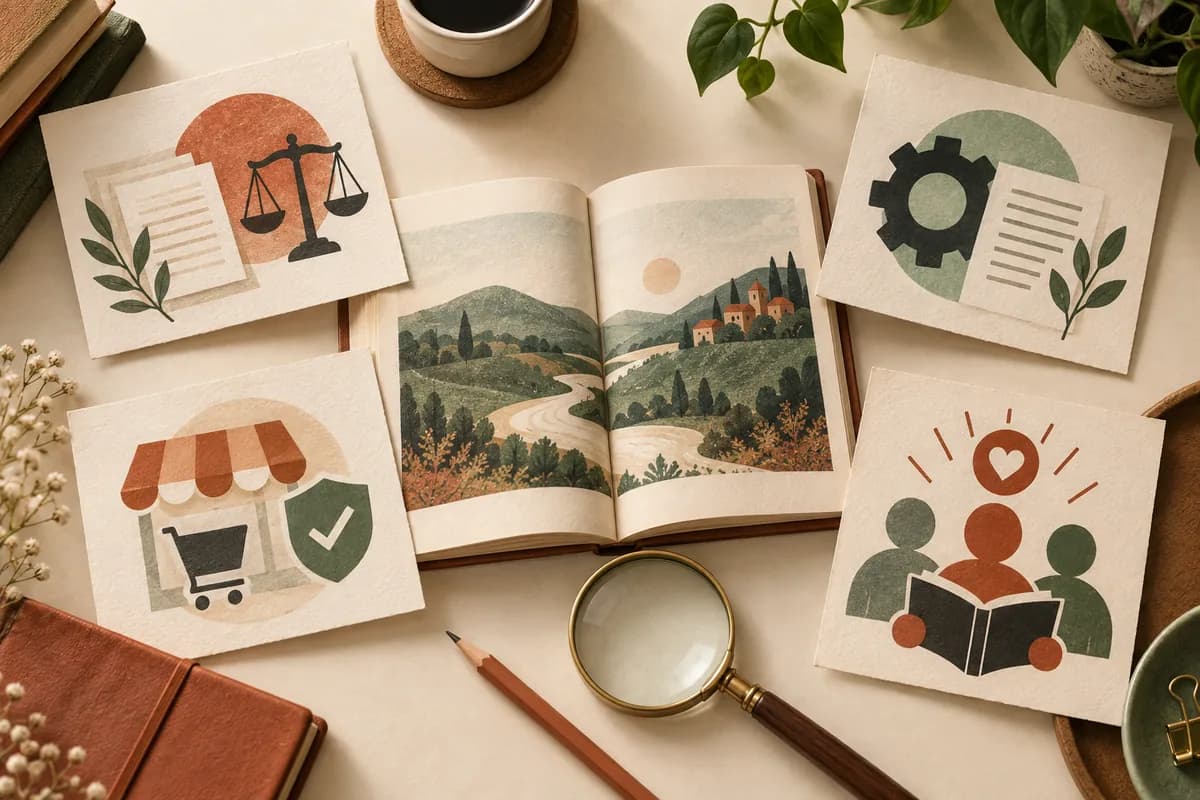
Treat permission, tool terms, store rules, and reader value as separate checks. The page graphic above shows the sequence, but it is not a legal test. You can satisfy one and fail another. A contract can allow commercial use of output while a copied passage still violates someone else's rights. A store can accept a file while a misleading description gives readers a poor experience. A beautifully designed book can still contain client information that should never have been uploaded to an AI service.
| Check | Question to answer | Evidence to keep | Typical mistake |
|---|---|---|---|
| Input rights | May I use the source text, images, data, and examples? | Licenses, permissions, original notes | Uploading a client report without consent |
| Tool terms | Does the tool permit this commercial use? | Applicable terms and plan at creation | Assuming every account tier has the same terms |
| Store rules | Does the format and disclosure meet this store's policy? | Submission answers, listing copy, current policy link | Treating Etsy rules as KDP rules |
| Reader value | Is the book accurate, usable, and honestly described? | Editorial review, test reader notes | Selling a fluent draft as an expert manual |
Write the evidence in a simple ledger. For each asset, note where it came from, who made it, what license applies, and where it appears. For each factual claim likely to change, note the source and check date. For each platform, note which edition you submitted and which questions you answered. A spreadsheet is sufficient. You do not need an elaborate compliance system to be substantially more careful than an author who publishes the first export.
Pause if any row is unresolved. “The model generated it” is not an answer to whether the source material was licensed. “The store let me upload it” is not proof that the listing complies with all rules. These distinctions become especially important when you create several formats—an ebook, printable PDF, paperback, and bundle—because each may use different assets and be sold under different terms.
Does commercial use permission mean I own the book?
No single answer covers every tool, work, and jurisdiction. A tool's terms may grant you permission to use output commercially, but that is a contract question. Copyright protection is a different question. Third-party rights in inputs or recognizable output are a third question. Authors often collapse all three into “I own it,” which hides the specific risk they need to resolve.
Before you create a book, read the tool's current terms for your plan and intended use. Check whether you may sell output, whether you owe attribution, whether the provider may use uploaded material for training or service improvement, whether output may be similar to another user's output, and whether restrictions apply to certain content or accounts. Save a dated copy or link. Terms can change. If a collaborator used a different tool for the cover or illustrations, review those terms too. A manuscript can have several distinct rights chains.
Then identify your own contribution. A human-authored introduction, original examples, revised structure, selected and arranged material, and original diagrams may have a different legal position from unedited machine output. The U.S. Copyright Office's AI resources explain how its registration approach considers human authorship. They do not make a universal statement about every country or every manuscript. If registration or exclusive licensing is material to your business, get advice based on the actual work and keep drafts that show your creative decisions.
Finally, check anything you supplied or incorporated. Permission from an AI vendor does not override a photographer's license, a publisher's rights in an excerpt, a person's privacy interest, or a client's confidentiality agreement. An AI-made illustration of a protected character or a near-copy of a living artist's image deserves scrutiny even if you typed the prompt yourself. Treat output as material to review, not a rights certificate. Our ethical business-book guide explains how to keep evidence and examples honest while drafting.
What does KDP require for AI-generated books?
Amazon KDP currently requires a publisher to inform it of AI-generated text, images, or translations when publishing a new book or editing and republishing an existing one. Its content guidelines distinguish that from AI-assisted work. If you created the content and used AI to edit, refine, error-check, or brainstorm, KDP describes that as AI-assisted and says that particular disclosure is not required. If an AI tool created the actual text or image, KDP calls it AI-generated even if you substantially edit afterward. Answer the submission questions about what happened, not what you would prefer the category to mean.
The same page says publishers remain responsible for intellectual-property rights and content quality. It applies its guidelines to the title, cover art, and description as well as the interior. A polished cover cannot promise a deeply researched field manual when the inside is a generic set of short chapters. A generated cover image also belongs in the disclosure analysis. If you commissioned a human artist who used AI in their process, ask how the asset was made before submitting. If your book includes generated translation, check that category explicitly; a fluent translation can still invert an instruction or miss a cultural nuance.
KDP's rule is a platform rule, not a declaration that disclosure automatically makes every book acceptable. It also has restrictions on infringing content and material that creates a poor customer experience. Read the Kindle content quality guide when validating navigation, duplicates, and formatting. If you create a paperback, use its print preview and proof process to catch trim, bleed, margin, and legibility problems. If you change the manuscript later, revisit the submission answers. A generated chapter added in the second edition changes the process history.
Keep a short publication record: manuscript version, cover version, which portions were generated, the source of all nonoriginal assets, the date you reviewed the policy, and the answers you selected. This makes a correction much easier. Our KDP AI disclosure guide walks through the platform question in more detail, while the 2026 royalty guide helps with price decisions after the file is ready.
Can I sell an AI-assisted digital book on Etsy?
Etsy permits original designs as digital downloads under its “Designed by a seller” category, and its seller guidance explicitly says this category includes seller-prompted AI creations. It says digital items must be made and/or designed by the seller and that seller-prompted AI creations must disclose AI use. Do not infer from that permission that any generated file qualifies. Etsy also applies creativity standards, prohibited-item rules, image requirements, intellectual-property rules, and listing rules. Review the current policies for the exact product and location.
A practical listing should make three things obvious: what the buyer receives, what they can do with it, and how much of the design is yours. Show representative interior pages, state the file types and page size, explain whether the download is editable or printable, and describe any software needed. If AI was part of the creation, disclose it as required without turning the listing into a vague technical essay. A concise statement such as “The seller designed and edited this workbook; AI tools assisted with initial text and illustrations” is useful only if true and consistent with Etsy's current disclosure options.
Check the file experience on the device your buyer will use. A printable PDF may need generous margins and dark text; a phone-first guide may need a reflowable format. Test actual downloads and links. Etsy's digital listing help describes file upload constraints and how buyers receive files. The format changes the support questions you will get. A preview image that shows a styled spreadsheet should not deliver only a static PDF unless you say so.
Etsy is a marketplace for distinctive seller-created goods, so editorial originality matters commercially as well as under policy. A book tailored to a specific audience, with tested exercises and real examples, has a clearer reason to exist than a stack of broadly generated pages. The workbook selling guide goes deeper on format, listing design, fees, and launch tests. The Etsy and Gumroad guide compares channel mechanics.
What about Gumroad and a direct store?
A direct-download storefront gives you more control over the landing page, bundle, and customer relationship, but it does not erase rights or consumer-protection obligations. Read the storefront's current terms and prohibited-product policy for your subject and location. A payment processor may also have restrictions, and those restrictions may differ from the storefront's merchandising guidance. Do not interpret a successful upload as a legal approval.
Gumroad's current fee page is the right place to check its pricing before calculating a margin. Fees, payment processing, taxes, refunds, and chargebacks can change. Model the net proceeds using your expected price and buyer geography rather than repeating a percentage from an old blog post. For a low-price ebook, a fixed per-transaction component can materially change the economics. The point of a direct store is often the ability to serve a narrow audience and keep improving the product, not simply to find the lowest displayed fee.
Build a product page that accurately shows the book. Name the intended reader, the problem, the deliverables, the format, the version date, and the limits. Include a sample chapter or several real pages. If the book uses AI, describe the human editorial process where it helps a buyer judge reliability. Avoid using “written by experts” unless you can identify the people and their role. For sensitive topics, a transparent source list and update history are more persuasive than generic badges.
The sale is only the beginning. Deliver a clean file, an accessible receipt, and support for download problems. Record what version the buyer received, particularly if the book contains changing platform advice. A direct store can make it easier to notify customers of a revision, but you must actually maintain the book. Link back to an owned page so search visitors can discover the guide without depending solely on marketplace ranking.
Can AI-generated text be copyrighted in the United States?
The question depends on the human-authored expression in the particular work. The U.S. Copyright Office's AI initiative and registration guidance discuss human authorship in works containing AI-generated material. The Office has explained that material produced by a machine without sufficient human creative control may not receive copyright protection on its own, while human-authored contributions and creative selection or arrangement can be considered. Do not treat this as a blanket rule that any use of AI destroys copyright in a whole book. Do not treat a tool's commercial-use permission as a promise that every generated sentence receives exclusive protection.
This distinction matters when you want to license the book, stop unauthorized copying, or register it. A work can contain protected human passages and unprotected material. Whether your particular revisions are sufficiently creative is a fact-specific legal question. Routine proofreading is not the same thing as writing substantial original analysis. Prompting itself may express intent, but the legal treatment of the resulting output requires more than a slogan about who “owns” a prompt. If exclusivity is important, build the value around contributions you can clearly identify and document.
Keep drafts, outlines, notes, source materials, edits, and design decisions. Mark which passages began as generated output and which you wrote. Record the selection and arrangement choices that make the work coherent. This record is useful for an honest registration application and for resolving a later collaborator dispute. It also improves the book: once you see how much of the value depends on generic output, you know where to add your expertise.
Copyright is only one form of risk. A passage may be unprotectable yet still breach a confidence or privacy obligation. A title may raise trademark issues even when the interior is original. A photograph may be licensed for a blog but not a paid ebook. Maintain a rights inventory across the whole package, including cover, interior, tables, illustrations, excerpts, and promotional images.
What does a meaningful human contribution look like?
A meaningful contribution shows up in the book's choices, not in a marketing claim that a human was “in the loop.” The author selects a real reader problem, frames a distinct thesis, supplies observations or research, tests the method, adds exceptions, edits the argument, and takes responsibility for the finished result. If you removed the generic output, would there still be a useful framework, original examples, or a clear editorial perspective? That is a better practical test for product quality than a percentage of words typed by a person.
Consider a short guide for independent fitness coaches. A generic AI draft might list “define your niche, create content, and measure results.” A practitioner can instead explain how a new coach chooses between three offer types, show a worked price example, provide an intake worksheet, identify situations that require licensed advice, and explain what to measure after the first ten client conversations. The specificity comes from the practitioner's understanding, sources, and test users. It is what a buyer cannot get from an interchangeable prompt.
A human review must be more than a skim. Verify every factual statement, number, quote, and source. Ask a representative reader to follow the steps without coaching. Inspect every table on mobile and in the exported file. Check that examples are labelled real, anonymized, composite, or hypothetical as appropriate. If a method does not work in an edge case, say so. The editorial work should narrow uncertainty for the reader, not hide it beneath confident prose.
Our consultant book guide shows how to turn professional experience into a useful, focused book. A first draft can be made quickly in EarnDraft, but the differentiating parts—your source material, decisions, and review—must come from you.
What inputs should never go into a drafting tool casually?
Do not upload material merely because it would make prompting convenient. Client records, unpublished manuscripts from other authors, internal financial data, health information, personal contact lists, confidential strategy documents, paid course materials, and licensed images may carry obligations to someone else. Check consent, contract terms, and tool data practices before using them. If the answer is uncertain, create a sanitized summary or write from your own nonconfidential notes.
Anonymization takes more than replacing names. A combination of role, city, industry, project size, dates, and unusual events may identify a client. If the book is about a small field, even “a regional nonprofit” can be recognizable. Ask for permission where possible; otherwise use a clearly labelled hypothetical or composite example that does not leak a real person's details. Never invent a client's approval, a review, or a testimonial to make a generated case study look authoritative.
Public information also deserves scrutiny. A web page may be visible but copyrighted; a chart may allow linking but not republication; a photograph may have a license limited to noncommercial use. Summarize facts in your own words, cite the source, and obtain a license for substantial reproduced material. For images, keep the license and attribution requirements with the asset. For a generated image, review the prompt and output for copied marks, recognizable people, and misleading context.
Use the tool's privacy controls based on its current documentation, and do not promise collaborators that a service never retains input unless you have confirmed the exact plan and settings. Where confidentiality is central, consult the client agreement and the vendor's data terms. The safest content pipeline starts with material you created or have permission to use, then records every addition.
How can I verify an AI draft's claims?
Assume that fluent prose can be wrong. Make a claim ledger before polishing. Extract every statement a reader could check: dates, figures, legal rules, platform fees, research findings, quoted text, tool capabilities, and named examples. Put the exact claim in one column and the primary source in another. Record what the source actually says, its date, and when the claim needs rechecking. If you cannot verify a claim, remove or narrow it.
| Claim type | Check against | Editing action |
|---|---|---|
| Platform rule | Official current policy page | State store and date; link directly |
| Price or fee | Official pricing page or calculator | Show assumptions; avoid timeless claims |
| Research result | Original paper or dataset | Describe population and limits |
| Quote | Original text, recording, or permission | Use accurately or paraphrase |
| Personal result | Your records and consent | Qualify scope; do not invent a testimonial |
| How-to step | Hands-on test with the current interface | Update screenshots and wording |
Do not cite an answer engine's summary as the only evidence for a store rule. Open the original page. Check whether a source addresses the exact claim rather than a nearby topic. For example, an article about general copyright ownership may not answer whether a specific stock photo license permits resale inside a template. If a rule varies by location, name the location. If a fee varies by transaction, show an example as an estimate with inputs instead of promising a fixed net amount.
After fact-checking, test the procedure. Follow the book's instructions as if you were a first-time reader. Can you finish the worksheet? Do links work? Does the promised template exist? Is a screenshot still current? Ask a test reader to explain where they hesitated. Those notes are evidence of usefulness that generation alone cannot provide.
What are the highest-risk book topics?
Risk rises when a reader may rely on the book to make a consequential decision or when the subject changes quickly. Medical, mental-health, legal, tax, investing, employment, safety, and regulated-business advice can cause harm when a generated answer sounds precise but is wrong. A self-published book in these areas needs qualified subject review, current primary sources, careful scope, and explicit limits. A generic disclaimer does not cure an incorrect instruction.
You can often narrow the book to a safer and more useful job. Instead of a definitive tax manual, make a workbook for organizing questions and records to bring to a licensed professional. Instead of diagnosing an illness, help readers prepare a symptom log for a clinician. Instead of promising investment returns, explain a budgeting process with clearly hypothetical examples. Even these narrower products need fact-checking and should not imply a credential the author lacks.
Risk also appears in apparently light topics. A travel guide with outdated opening hours wastes a trip; a children's activity book with unsafe instructions can injure; a career guide that misstates visa rules can mislead a reader. Build an update plan proportionate to the stakes. Date changing guidance, link to official sources, and state when the guide was last checked. If you cannot maintain a high-change topic, choose a more durable angle.
Decide who reviews what before publication. A target reader tests clarity. An editor checks structure and claims. A qualified professional reviews specialist advice where needed. A printer proof checks physical layout. Keep these roles distinct. “Human reviewed” means little unless you know what the person reviewed and what expertise they had.
How do I use photographs, covers, and AI art safely?
A book is more than its manuscript. Its cover, diagrams, tables, typography, and promotional images all have sources and permissions. For stock art, read the license for commercial use, print runs, templates, resale, and attribution. Some licenses distinguish an image embedded in a finished book from an image sold as a reusable design asset. Keep the receipt and terms with the original file. Do not rely on a search result's “free” label.
For AI art, check your image tool's terms and the store's disclosure rules. Avoid prompts that ask for a living artist's style, a well-known character, a brand mark, or a real person's likeness without permission. Inspect the result at full size: hands, lettering, charts, maps, logos, and depicted products can be inaccurate. If an illustration appears to document a real event or person, make its illustrative status clear. A generated chart should not be presented as measured data.
Cover design has a separate truth-in-advertising role. It should signal the actual topic, audience, and format. A cover that says “certified,” “official,” or “doctor-approved” needs a basis. A mockup should not imply a hardcover when the buyer receives a PDF. If you use a testimonial or award mark on the cover, document the permission and accuracy. KDP's content guidelines include the cover and description, so interior compliance is not enough.
Check accessibility and readability. Use sufficient contrast, legible type at thumbnail size and on a phone, and descriptive alt text on your own site. In a PDF, keep text selectable when possible and give charts explanatory captions. The best graphic is not the most elaborate one; it is the one that helps the buyer understand a comparison or complete a task.
What should the product description say?
The listing is a promise. State the reader, the outcome, the contents, the format, the length or page count when meaningful, and the boundaries. If the book is an introductory workbook, call it that. If it includes editable files, say which. If a sample chapter is available, link or show it. If the advice depends on policies that change, show the edition date. Avoid implying that a generated draft is independently researched when it has not been checked.
| Misleading shortcut | Stronger description |
|---|---|
| “Complete expert guide to every publishing law” | “A practical checklist for preparing a short ebook; verify local legal rules separately” |
| “Guaranteed passive income” | “A worksheet for estimating costs and testing demand” |
| “Includes 100 templates” when most are repeated | “Includes 12 distinct prompts and three worked examples” |
| “Doctor approved” without review | “Reviewed for readability by two target readers” only if true |
| “Hardcover book” for a digital file | “Printable PDF download, 8.5 × 11 inches” |
Do not use an AI-generated review, fake purchase count, invented case result, or stock portrait as social proof. If a real person endorses the book, use their actual words with permission and follow applicable disclosure requirements. The FTC's endorsements and reviews guidance is a primary U.S. source for this area. A credible listing can be persuasive without a wall of borrowed authority.
A direct page gives you room to show a real excerpt and answer format questions. Marketplace fields may be shorter, so lead with the use case and deliverables. Match every image to the current edition. If you update the file, update the preview. The reader should receive the same product they believed they bought.
Which format makes sense for an AI-assisted book?
The format should serve the task. A reflowable ebook works well for narrative instruction and reading on different screens. A PDF works well for printable worksheets, diagrams, or fixed layouts. A paperback can be useful when readers need to write by hand or give the book as a physical object, but it adds trim, ink, binding, and proofing decisions. A bundle can offer both reading and action formats, though it also doubles the testing surface.
Do not export the same layout to every channel and assume it works. A wide comparison table may look fine in a desktop PDF but become unreadable on a phone. A handwritten worksheet may fail in a reflowable ebook. An AI-generated illustration may look passable at screen size but fall apart in print. Test actual files on a phone, desktop reader, and print proof where relevant. Let the worst reading condition reveal your next edit.
For each format, list what the buyer can do. Can they print it? Fill it digitally? Copy a template? Search the text? Follow internal links? Will their device open the file without a paid app? A sales page that answers these questions prevents support problems and refunds. The workbook guide has a format decision table, while our ebook launch checklist covers final file checks.
If your book includes active links or current rules, add a version date and an owned update page. Do not rely on a static file to remain right forever. The format decision is also an editorial decision: a book that requires constant updates may be better supported by a shorter guide with linked current resources than by a supposedly permanent encyclopedia.
How should I price it?
Price the outcome and the audience, then check the channel economics. A short, specific workbook that saves a buyer time can be more valuable than a long generic book. But the listing must show the value honestly. Compare competing products for format, depth, support, and audience fit rather than copying the median price. Ask a small set of target readers whether the sample helps them complete a task before assuming a price problem explains weak sales.
For KDP ebooks, royalty options depend on price, marketplace, and other conditions. The KDP royalty guide provides a worked comparison and links to Amazon's current terms. For Etsy, check listing, transaction, payment, advertising, and tax details on its fee basics page. For Gumroad, use its current fee page. Do the arithmetic for your expected sale rather than advertising gross price as earnings.
| Decision | Question |
|---|---|
| Reader value | What result or saved effort can a buyer see in the sample? |
| Channel cost | What remains after platform and payment fees at this price? |
| Production cost | What did research, editing, design, and proofing cost? |
| Support | Will buyers need help with files, updates, or templates? |
| Positioning | Does the title and preview justify the promise at this price? |
Test one variable at a time. Improve the sample or listing clarity before discounting a product that shoppers do not understand. If buyers open the sample but do not purchase, talk to them about missing information. If buyers purchase and request refunds, inspect the product and promise. Pricing is a learning process, not proof that a book is good.
What should I disclose to readers?
Store disclosure and reader disclosure serve different purposes. KDP asks specific questions under its AI-content policy; Etsy has its own seller-prompted AI disclosure requirement. Answer each platform based on the actual process. A reader-facing note can explain who developed the ideas, what AI did, and what human review occurred. It should be precise rather than theatrical. “The author wrote the examples and checked the sources; AI assisted with outlining and sentence-level editing” is informative if true.
Do not use disclosure as a substitute for quality. “AI generated” does not excuse invented facts. “Human reviewed” does not mean reviewed by a qualified specialist. Name material limits: a workbook may be educational rather than individualized professional advice; a fee table may have been checked on a particular date; a hypothetical example should be labelled as hypothetical. These notes help readers use the book correctly.
Place information where it is useful. A brief process note can go in the introduction or back matter. A source note should sit near a changing claim or in a linked reference section. A listing should disclose what the store requires and should not hide a material production fact that would affect the buyer's understanding. Keep the language readable; the buyer did not come to read a software audit log.
If a book contains real interviews, client examples, or quoted people, disclosure also means accurate attribution and permission. If a collaborator contributed research, design, or editing, credit them appropriately. The ethical business-book guide gives a fuller editorial workflow for these decisions.
Can I reuse one generated book across several marketplaces?
Often you can distribute a book in more than one place, but first check each contract and any exclusivity program. KDP Select, for example, imposes digital exclusivity during enrollment under its terms. Do not enroll an ebook in an exclusive program and keep selling the same digital content elsewhere without understanding the terms. If you use a distributor, check what rights you grant and whether it creates duplicate listings.
Each channel needs its own package. An Etsy printable PDF, a Kindle ebook, and a direct-store bundle may share core content but need different files, cover previews, descriptions, disclosure answers, and support notes. Track the edition in every location. If you correct a factual error, update each channel and any sample page. A stale listing can keep making a false promise after the manuscript is fixed.
Do not flood stores with trivial variants that differ only by title or color while claiming they are distinct comprehensive books. Focus on products with a clear reader and an identifiable use. If you translate the book, review the translation and platform disclosure rules. A generated translation can be fluent but inaccurate, and terms for translated works may involve the original author's rights.
Internal links can help people navigate your own site between related free guides, but they should not be stuffed into the purchased file as a series of ads. A useful book can point to an update page or supplementary template. The goal is to extend value after purchase, not to send the reader through a funnel before delivering the promised answer.
What is a sensible production workflow?
Start with a one-page brief: target reader, narrow problem, promised outcome, examples you can legitimately use, source list, and format. Write an outline in your own words. Then use AI, if useful, to suggest missing questions or alternative structures. Reject sections that do not help the reader finish the job. This creates an editorial standard before the tool produces a flood of plausible prose.
Draft chapter by chapter from source notes. Mark generated passages in your working copy. Replace generic claims with your reasoning and tested examples. Open every source. Build any worksheet and complete it yourself. Ask a representative reader to use it without explanation. If the book covers a specialist subject, arrange review from someone qualified. Run separate passes for factual accuracy, rights, accessibility, and file behavior. A single proofreading pass will miss different categories of error.
Before exporting, create the rights and disclosure record. Check every image and excerpt; record the tool used for generated text, art, or translation; answer the current store questions; and write the listing from the actual finished file. Export and inspect all formats. For print, order or inspect a proof when practical. For digital, make a test purchase or download and open the file as a buyer would.
After publication, watch support questions, reviews, and changes in rules. Correct errors in the book and sample. Keep a version history with dates and changes. If a platform updates disclosure or file requirements, revisit the listing. A book is an asset that requires maintenance when it teaches changing processes. Our launch checklist can serve as the final operational pass.
What should I do if I already published a weak AI book?
First, inspect the product honestly. Read the listing and the file side by side. Make a list of claims you cannot support, examples that sound real but are hypothetical, missing permissions, broken links, formatting failures, and exercises that do not work. Prioritize harm and misleading promises. If the book gives unsafe or false advice, pause promotion and correct it promptly through the store's update process.
Then rewrite around a specific reader problem. Do not pad the book to make it seem substantial. Remove repeated chapters, add an original framework, replace invented evidence with primary sources, and show one fully worked example. Ask a reader to test the improved edition. If the problem is a rights or confidentiality breach, seek qualified advice and follow the relevant platform's correction or takedown path. If buyers received a materially different product from the listing, address that directly rather than silently swapping the file.
Document the update. Note what changed, when, and which channels received it. Correct samples and promotional posts where practical. If a claim was shared widely, a public correction may be appropriate. A visible revision record can rebuild trust better than a quiet claim that the first edition was always accurate.
The lesson is not that AI is unusable for books. It is that speed moves the bottleneck to judgment. You can produce more text in an afternoon than you can responsibly verify. Set a smaller scope that you can research, test, and maintain. A reliable 40-page guide can serve a reader better than a 300-page compilation that nobody has checked.
Frequently asked questions
Is selling an AI-generated book illegal?
There is no universal rule making every AI-generated book illegal. Legality depends on the content, rights, claims, location, and other facts. A book may violate copyright, privacy, contract, or consumer-protection rules even if an AI tool permitted commercial use of its output. Check those questions separately and seek professional advice for a specific dispute or regulated subject.
Does KDP ban all AI books?
KDP's current content guidelines require disclosure of AI-generated text, images, and translations in its publishing flow and make the publisher responsible for rights and quality. They do not state a blanket ban on every AI-generated book. A title can still be rejected or removed for other policy reasons.
Do I need to tell Etsy that AI helped make a digital book?
Etsy's seller guidance says seller-prompted AI creations must disclose AI use. The product must also satisfy its seller-design and other policies. Read the current listing flow rather than assuming KDP's disclosure categories apply there.
Can I copyright the entire output?
In the United States, copyright analysis looks at human-authored expression in the particular work. The Copyright Office's AI resources are the primary source for its position and registration process. A tool's permission to sell output is not the same as a guarantee of exclusive copyright protection in every generated element.
Can I sell a generated book with stock images?
Only if the stock license permits the intended use and the rest of the book complies with the store's rules. Verify commercial ebook and print rights, resale or template restrictions, required attribution, and any use limits. Keep the license with your project record.
Is a disclosure enough to make a book trustworthy?
No. A disclosure tells a store or reader how the content was made. Accuracy, useful structure, tested instructions, permissions, and honest marketing still need independent work. If a claim is unsupported, remove it or substantiate it; do not rely on a general process note.