Blog · Repurposing
How do you turn blog posts into an ebook?
Your archive already holds a book — scattered across posts, drafts, and tangents. Here is the method, or automate it with Course to Ebook Generator.
EarnDraft Team · Published September 11, 2026 · Updated September 27, 2026 · 8 min read
In this post
Pick posts that answer one question
A repurposed ebook fails when it is a greatest-hits folder. It works when every included post answers one reader question from a different angle. State that question in a sentence before selecting anything — posts that don't serve it stay on the blog.
Pull your analytics and pick the proven winners first: traffic, comments, and conversion tell you which posts earned their place. Five to eight strong posts beat twelve loosely related ones.
Restructure around reading order
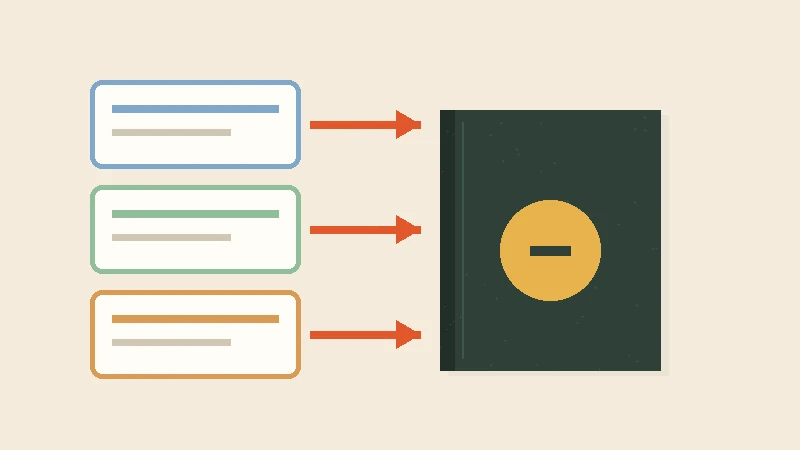
Blog order follows publishing history; book order follows the reader's journey. Re-sequence ruthlessly: merge posts covering the same ground, split bloated ones carrying two ideas, and write fresh transitions so chapters hand off instead of restarting.
Map the result onto a five-chapter spine — problem, fast win, depth, proof, next step — the same shape our course repurposing guide uses. Familiar structure, new material.
- Merge overlapping posts into single chapters.
- Cut intros that re-explain what the book already covered.
- Move scattered proof into one dedicated chapter.
Repurpose the archive this week
Feed in your best posts; get back a structured, sellable ebook.
Add the book-only material
Repurposed books need three things posts don't: an introduction that sells the rest of the book, a conclusion pointing at your next offer, and at least one exclusive chapter rewarding buyers. That exclusive chapter is what makes the purchase feel fair while the posts stay public.
Update every example and screenshot while you're in there. Nothing dates a repurposed book faster than a three-year-old case study carried over untouched.
Price it and place it
Price below your flagship products: the repurposed ebook is an entry point, not the main event. Then distribute where the blog isn't — Etsy for discovery, your newsletter as a tripwire, bundles with related creators.
Keep the posts live. They are now the book's marketing team: add a callout to each sourced post pointing at the finished ebook, and every old URL starts selling the new asset.
Find the book hiding between the posts
A series of related articles is not automatically a book. Posts often answer search questions independently, repeat introductions, and assume readers arrive from different contexts. Inventory the posts by the reader decision they help with. Then write the book’s single promise and a sequence that takes a reader from starting point to outcome. Some posts will become chapters; others will be examples, sidebars, or links to later reading. A few may not belong at all. Cutting a popular post can make the book stronger if it serves a different job.
Map each candidate article to the new sequence. Mark repeated definitions, contradictory advice, stale facts, and transitions that only make sense on a website. Rewrite the opening of each chapter so it follows the previous one rather than greeting a fresh search visitor. Add connective material where the book needs a dependency: a choice before a method, a method before an example, an example before a checklist. This is the editorial work that turns a collection into a coherent reading experience.
Check rights and source dates before copying. Images, quotations, guest contributions, and embedded charts may have been licensed for the blog but not for an ebook sold elsewhere. A post about platform prices or policy may have been correct when published and wrong now. Keep a claims log with the source URL and date checked for each time-sensitive statement. Readers will judge the book as one current product, not forgive stale sections because they began as old articles.
A strong book adds value beyond the free archive. That can be a more useful order, a worked case that crosses several posts, editable templates, a decision matrix, or a concluding plan. It need not hide the original posts. Explain what the book packages and deepens. If the paid file is merely a PDF of pages that remain online, buyers may feel the offer was unclear. Show the interior and name the additional value before checkout.
| Blog pattern | Book edit | Reader benefit |
|---|---|---|
| Repeated introductions | One clear opening | Less friction |
| Independent answers | Dependency order | A teachable path |
| Stale screenshots | Updated evidence | Trustworthy instructions |
| Loose endings | Cross-chapter action plan | A usable result |
Keep the original posts useful after publication
Draft the book in one canonical document so terminology and examples stay consistent. Use heading styles and a source list from the beginning. After the structural edit, let a reader who has not seen the posts test the sequence. Ask them what the book promised, which chapter was hardest to use, and whether the ending helped them act. Their feedback is about the book as a whole; analytics from individual posts cannot substitute for it.
Create a reader-facing preview that shows the new value. A contents page can demonstrate the progression; a complete sample chapter can demonstrate the teaching quality. Show one table or worksheet if it is central to the offer. Be specific about file formats and update access. If the source posts are still public, say so. The book can still be worth buying because it saves navigation work and provides a better learning path, but readers should understand that distinction.
Keep the posts online when they remain accurate and useful. Add a relevant note to each one pointing to the book where the book solves the next problem. Avoid a generic banner pasted onto every article. A post about pricing should point to the pricing chapter or worksheet; a post about format should point to the file-quality section. This preserves the post’s search value and gives an interested reader a sensible continuation. Use descriptive links so a reader can judge the destination before clicking.
Schedule maintenance for both versions. When a platform fee changes, update the article, the ebook source, the download file, and any screenshots. Record an edition date and a short changelog. If you cannot maintain two divergent sets of facts, consolidate time-sensitive details on a source-linked web page and keep the book focused on durable decisions. Repurposing works best when it creates a maintainable system, not two conflicting archives.
Decisions that make the ebook more than an archive
Decide whether the book is a beginner path, a reference, or a workbook. The same article library can support all three, but the chapter order and additions will differ. A beginner path needs prerequisites and a clear progression. A reference needs strong navigation and concise entries. A workbook needs exercises and examples that help readers apply ideas. Choose one primary use and state it on the sales page. A book that tries to be every format can become a loose archive with a cover.
Look for gaps between posts, not only gaps inside them. A blog may have separate articles about choosing a platform and pricing a product, but no article showing how those choices interact. The ebook can add a worked case that follows one product from idea through pricing and launch. That connective analysis is original value. Label any invented scenario as illustrative, and use current source links for any platform details. The reader should feel the benefit of having the material considered together.
Protect search usefulness while editing. Do not remove a helpful article solely because it now appears in a book, unless it is truly obsolete. Update internal links to the most relevant chapter or sample, and keep the public page’s answer complete. If a post becomes a teaser with its core answer deleted, search visitors may be disappointed and the book offer may feel coercive. The book can sell the convenience, depth, and tools that the fragmented archive cannot provide as well.
Choose a revision owner. When an official source changes, somebody must update the post, book source, download, and product page. A small checklist of affected assets helps. If you cannot maintain every historical screenshot, remove it or replace it with a durable description and a link to the official current workflow. The goal is to make the second edition easier than the first, because a book built from live posts will continue to evolve.
Measure use, not just launch revenue. Which chapter do readers mention? Which template do they reuse? Which post sends readers to the sample? Questions and support messages can identify missing transitions that web analytics cannot reveal. Use that evidence to add a worked example or clarify a step, and record the change in an edition note. Repurposing becomes a learning loop when the public archive and paid book improve one another.
Sources checked
Platform rules and prices can change. Check these primary sources before you publish or price your book.
Questions, answered
Written by the EarnDraft team — we build the tool that turns one sentence into a sellable ebook. How we write and check our guides.
Turn one idea into a finished book
Free to start · No credit card · Review before publishing